↓
 

Geschichte & Geschichten

Blog des Museums Burg Posterstein

Geschichte & Geschichten
  • Start
  • Burg Posterstein
  • Podcast LeseZEIT
  • Kinderburg
  • Salon Europa
  • Landschaft nach der Wismut
  • Weihnachtskrippen
  • English
  • Datenschutzerklärung
  • Impressum

Schlagwort-Archive: Latvia

The Welker Collection from Posterstein is heading to Courland

Geschichte & Geschichten Veröffentlicht am 13. Mai 2026 von Museum Burg Posterstein13. Mai 2026

Guests from Courland, in present-day Latvia, visited the Altenburg region on May 7 and 8, 2026. They are working for the Rundāle Palace Museum. The palace of the Dukes of Courland is also known as the “Versailles of the North” and attracts hundreds of thousands of visitors each year. The Latvians came to pick up loans from Museum Burg Posterstein for a special exhibition. This is because parts of the Welker Collection from Posterstein will be on display this summer at Mežotne Palace, the birthplace of Duchess Anna Dorothea of Courland. The exhibition “The Court of the Muses. The Salon of Duchess Dorothea of Courland at Löbichau Palace in the Caricatures of Ernst Welker” will be on view from June 5 to September 3, 2026.

The Duchess as a Poodle?

Ernst Welker’s caricatures depict the Duchess, her daughters, and her guests as hybrid creatures, each accompanied by a humorous rhyme. It is likely that Welker, as the art teacher of the Duchess’s granddaughter, presented the drawings in the salon, and that the Duchess had enough of a sense of humor to allow him to portray her as a loyal poodle.

Der Maler Ernst Welker stellte die schöne Herzogin als Pudel dar. Der französische Diplomat Talleyrand schrieb ihr hunderte von Briefen.
The painter Ernst Welker depicted the beautiful duchess as a poodle.

The exhibition is curated by the Rundāle Palace Museum, with which the Posterstein Museum team has maintained a relationship for decades. At the end of this exhibition, Franziska Huberty and Marlene Hofmann, staff members at the Museum Burg Posterstein, will travel to Latvia to give a lecture on Löbichau, Tannenfeld, and Posterstein Castle.

The caricatures from the Welker Collection have been digitized and can be viewed in the German Digital Library and in the European online library Europeana (link to the Welker Collection).

Visiting Tannenfeld, Löbichau, the church in Großstechau, and Posterstein Castle

During their visit to the Altenburg region, the Posterstein museum team, with the support of the Großstechau parish, first guided their colleagues from Courland through the local church. Großstechau Church was the private chapel of Anna Dorothea of Courland. She had a VIP box there, and her funeral was also held here.

Blick auf die herrschaftliche Loge der Herzogin von Kurland in der Kirche Großstechau
From the gallery, you can see the Duchess of Courland’s box in the church in Großstechau.

The tour group then viewed Löbichau Castle—which the duchess had expanded based on the design of her birthplace, Mesothen Castle, and which no longer exists in its original form—from the outside, and continued on to Tannenfeld.

Fünf Menschen stehen im Schlosspark Tannenfeld, im Hintergrund blühen Rhododendren
The Latvian museum staff and Marlene Hofmann from the Museum Burg Posterstein in Tannenfeld Castle Park.

During the Duchess of Courland’s time, Tannenfeld Castle was only one-third of its current size and served as a summer residence for her daughters and family. Sensational cultural events to entertain the guests at Löbichau were also held at Tannenfeld under the Duchess’s direction. The final stop on the tour the following day was the Museum Burg Posterstein and its permanent exhibition on the Duchess of Courland’s salon.

Zwei Frauen in der Postersteiner Ausstellung zur europäischen Salongeschichte
Sabine Hofmann from the Museum Burg Posterstein (left) with Līva Daniniece, Head of the Collections and Research Department at the Rundāle Palace Museum, during expert discussions on research into the Duchess of Courland at the Posterstein exhibition.

The history of European salons, with a particular focus on the salon of Anna Dorothea of Courland, has been a key area of research and exhibition at the Museum Burg Posterstein for decades. Here you find further information.

A Duke with a Business Acumen

Duke Peter of Courland experienced all the ups and downs that can arise in a life under the absolute power of the Russian rulers: a glorious youth was followed by a period of exile with his father and, in 1795, his abdication—forced by the Russian crown—and the surrender of the Duchy of Courland. He had been Duke of Courland since 1769. Two marriages ended in childless divorce. He hoped to secure an heir through his marriage to Anna Dorothea von Medem in 1779.

His relationship with the Courland nobility was marked by ongoing conflicts. The ducal title granted him access to the most important European noble houses, particularly the royal court in Berlin. The Duke was regarded as a shrewd businessman and a patron of the arts. At his residence in Mitau, he gathered artists and scholars and founded an academic gymnasium. Even after his abdication, he remained one of the wealthiest men in Europe. He invested abroad early on to ensure the financial security of his wife and daughters. Among other things, he acquired real estate, such as Friedrichsfelde Castle in 1785 and the “Unter den Linden” city palace in Berlin. As early as 1786, he purchased the Duchy of Sagan with the express permission for female succession in view of his eldest daughter Wilhelmine, as well as the estates of Nachod and Ratiborschitz in Bohemia.

Durch zwei Türen fotografiert die Räume zur europäischen Salongeschichte im Museum Burg Posterstein
The Burg Posterstein Museum has dedicated three exhibition rooms to the history of European salons, using the salon of the Duchess of Courland as an example.

Löbichau and Tannenfeld belonged to his wife, Anna Dorothea, who was many years younger than him. During the summer months, she hosted distinguished guests here in her salon—including Russian Tsar Alexander I, Duke August of Saxe-Gotha-Altenburg, and the writers Theodor Körner, Jean Paul, and Johann Wolfgang von Goethe.

Research at the Museum Burg Posterstein

For nearly thirty years, the Museum Burg Posterstein has been conducting in-depth research into the history of Anna Dorothea of Courland; it is internationally renowned for its research work and maintains a nationwide network. For years, it has been in contact with the Latvian Rundāle Palace Museum. For example, the Museum Burg Posterstein initiated the traveling exhibition “Milestones in the Life of the Duchess of Courland” and connected the historical sites across Europe by bringing the exhibition, following its opening in Posterstein (2006), to Latvia (Rundāle Palace, 2008), Poland (Sagan Castle, 2009), and France (Valencay Castle, 2007).

By Marlene Hofmann / Museum Burg Posterstein

Maybe the world – or at least Europe – has never been very big to begin with

Geschichte & Geschichten Veröffentlicht am 16. Oktober 2018 von Museum Burg Posterstein16. Oktober 2018

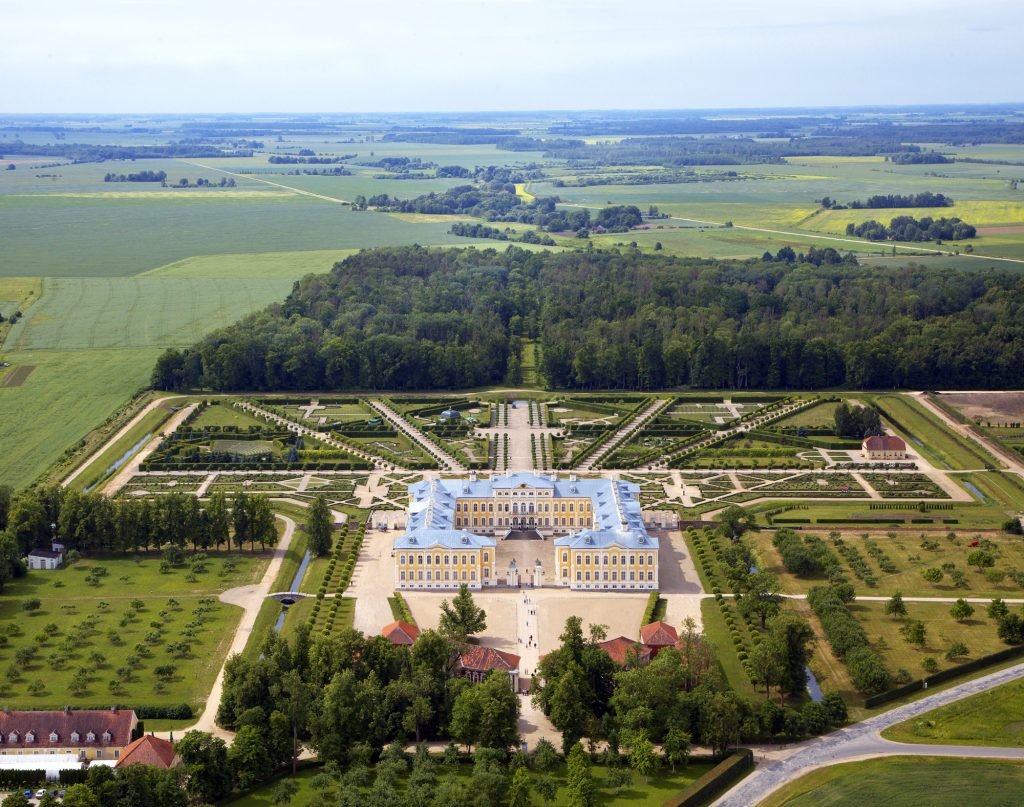
Schloss Ruhental (Rundāle), Lettland Foto: Imants Lancmanis/ Creative Museum

Schloss Ruhental (Rundāle), Lettland, Foto: Imants Lancmanis/ Creative Museum

Uldis Zariņš , member of Europeana Foundation Management Board, is sharing his views on Europe in our blog parade #SalonEuropa, which is part of the experimental exhibition #SalonEurope: analog meets digital Networking then and now – Europe means to me …? You can take part in the blog parade until October, 23rd 2018. If you don’t have a blog yourself, we share your article here in the museum’s blog.

Genealogic research is always a complicated endeavour. Often it is quite impossible to trace ones bloodlines past previous five or six generations, everything before that becomes a blur, a more or less educated guess. But even the information one manages to obtain often contains unexpected surprises. We consider ourselves to be pure Latvians, Germans, Poles, but then we suddenly discover that some of our ancestors actually have an Estonian, Swedish, French or Russian origin.

And who knows what surprises a 500 or 1000 years old history would hold, if we would be able to unearth it?

We now tend to think that the world is now getting smaller and smaller, as both technology and societal values makes us more mobile than we have ever been. But maybe the world – or at least Europe – has never been very big to begin with, and we are much more closely related to each other than we think and would sometimes like to admit?

If it is difficult to establish a clear historic identity on a personal level, then for nations it is quite impossible.

Would it be possible to distil a pure original essence of a national culture? I very much doubt it.

Culture has never recognised any borders, and as a result our national cultural heritage is but a patchwork of various cultural influences, hailing from all over the Europe, reflecting the trends and values of the times and often morphing into local variations. For example, Rundale palace has a significant place in Latvian cultural heritage as the most precious late baroque building in Latvia. However it can also be considered a part of German heritage, as it tells the story of its German masters, von Biron family, including duchess Dorothea, and thus creating invisible ties with the Burg Posterstein (and in a sense making it a part also of Latvian cultural heritage). Moreover, it can be said that Rundale Palace is also a part of Italian and Russian cultural heritage, as Francesco Bartolomeo Rastrelli, architect of the Rundale Palace, is an Italian (born in Paris) and most of his works are built in Russia.

Europe for me is first of all a shared cultural space

Thus Europe for me is first of all a shared cultural space – rich in its diversity, characterised by hundreds of different local flavours and colours, but based on the same fundamental values and traditions. Therefore we shouldn’t, for example, attribute Rundale to just Latvian or just German cultural heritage – it is truly a part of European cultural heritage. After all, it would not exist if Italians would not invent baroque in the first place. Culture is what makes us Europeans. European cultural bonds go back for hundreds and hundreds of years, shaping our attitudes and values, allowing us to recognise ourselves in the mirrors of other cultures. Culture is what stays with us when all the petty political squabbles have ended and been forgotten. Culture is what allows me to proudly say “I am a European”.

By Uldis Zariņš for #SalonEuropa

Geschichte & Geschichten

Das thüringische Museums Burg Posterstein bloggt seit 2011 über Geschichte und Geschichten aus Sammlung, Forschung und Museumsalltag.

IN ENGLISH: Since 2011 the German Museum Burg Posterstein writes stories about its collection, research and everyday life at the museum – here you find all texts in English.

Folgen Sie uns!

Logo YouTube     Logo Twitter      Logo Facebook     Logo Instagram      Logo Pinterest

Neuste Artikel:

  • The Welker Collection from Posterstein is heading to Courland
  • Postersteiner Sammlung Welker reist nach Kurland
  • Jahresrückblick 2025: Erfolgreiches Museumsjahr trotz Bauarbeiten
  • Sanierung des Bergfrieds der Burg Posterstein 2025
  • Sonst nichts Neues? – Resümee zur Sonderschau

Themen

  • Auf Deutsch (329)
    • #GartenEinsichten (4)
    • #SalonEuropa (7)
    • #Schlössersafari (12)
    • 16. Jahrhundert (3)
    • 17. Jahrhundert (6)
    • 18. Jahrhundert (7)
    • 19. Jahrhundert (72)
    • 20. Jahrhundert (13)
    • 21. Jahrhundert (6)
    • Adventskalender2020 (24)
    • Anderes (51)
    • Blogparade #SalonEuropa (8)
    • Ernestiner 2016 (16)
    • Kinderburg (27)
    • Kinderburg – DIY (7)
    • Kinderburg – Tour (1)
    • Kunst (25)
    • LeseZEIT (9)
    • Mittelalter (13)
    • Museumsverein (18)
    • Museumswelt (94)
    • Quer durch die Jahrhunderte (45)
    • Rittergüter (29)
    • Salongeschichte (15)
    • Sonderausstellungen (106)
    • Uranerzabbau (6)
  • In English (29)
    • 19th century (10)
    • Castles and manor houses (12)
    • Crossing centuries (5)
    • medieval times (1)
    • museum & social media (4)
  • Uncategorized (1)

Die Kinderburg

Kinderburg-Blog

Podcast LeseZEIT

Banner Podcast LeseZEIT auf Burg Posterstein

Digitale Ausstellungen

Landschaft nach der Wismut

Banner Landschaft nach der Wismut - eine digitale Ausstellung - im Hintergrund sieht man die neue Landschaft Ronneburg

#SalonEuropa
 Banner Online_Ausstellung SalonEuropa des Museum Burg Posterstein

#Schlössersafari

Banner Online-Ausstellung Schlössersafari

Weihnachtskrippen

Banner digitale Weihnachtsausstellung des Museums Burg Posterstein

Kontakt & Öffnungszeiten:

Museum Burg Posterstein
Burgberg 1
D-04626 Posterstein

Telefon: (034496) 22595

Aktuelle Öffnungszeiten

Impressum und Datenschutz

Impressum

Datenschutz

Museum Burg Posterstein in Thüringen - Ansicht vom Burgpark

Kontakt

Museum Burg Posterstein
Burgberg 1
D-04626 Posterstein

Telefon: (034496) 22595

Aktuelle Öffnungszeiten

Impressum und Datenschutz

Impressum

Datenschutz

©2026 - Geschichte & Geschichten Datenschutzerklärung
↑