
The Welker Collection from Posterstein is heading to Courland
Guests from Courland, in present-day Latvia, visited the Altenburg region on May 7 and 8, 2026. They are working for the Rundāle Palace Museum. The palace of the Dukes of Courland is also known as the “Versailles of the North” and attracts hundreds of thousands of visitors each year. The Latvians came to pick up loans from Museum Burg Posterstein for a special exhibition. This is because parts of the Welker Collection from Posterstein will be on display this summer at Mežotne Palace, the birthplace of Duchess Anna Dorothea of Courland. The exhibition “The Court of the Muses. The Salon of Duchess Dorothea of Courland at Löbichau Palace in the Caricatures of Ernst Welker” will be on view from June 5 to September 3, 2026.
The Duchess as a Poodle?
Ernst Welker’s caricatures depict the Duchess, her daughters, and her guests as hybrid creatures, each accompanied by a humorous rhyme. It is likely that Welker, as the art teacher of the Duchess’s granddaughter, presented the drawings in the salon, and that the Duchess had enough of a sense of humor to allow him to portray her as a loyal poodle.

The exhibition is curated by the Rundāle Palace Museum, with which the Posterstein Museum team has maintained a relationship for decades. At the end of this exhibition, Franziska Huberty and Marlene Hofmann, staff members at the Museum Burg Posterstein, will travel to Latvia to give a lecture on Löbichau, Tannenfeld, and Posterstein Castle.
The caricatures from the Welker Collection have been digitized and can be viewed in the German Digital Library and in the European online library Europeana (link to the Welker Collection).
Visiting Tannenfeld, Löbichau, the church in Großstechau, and Posterstein Castle
During their visit to the Altenburg region, the Posterstein museum team, with the support of the Großstechau parish, first guided their colleagues from Courland through the local church. Großstechau Church was the private chapel of Anna Dorothea of Courland. She had a VIP box there, and her funeral was also held here.

The tour group then viewed Löbichau Castle—which the duchess had expanded based on the design of her birthplace, Mesothen Castle, and which no longer exists in its original form—from the outside, and continued on to Tannenfeld.
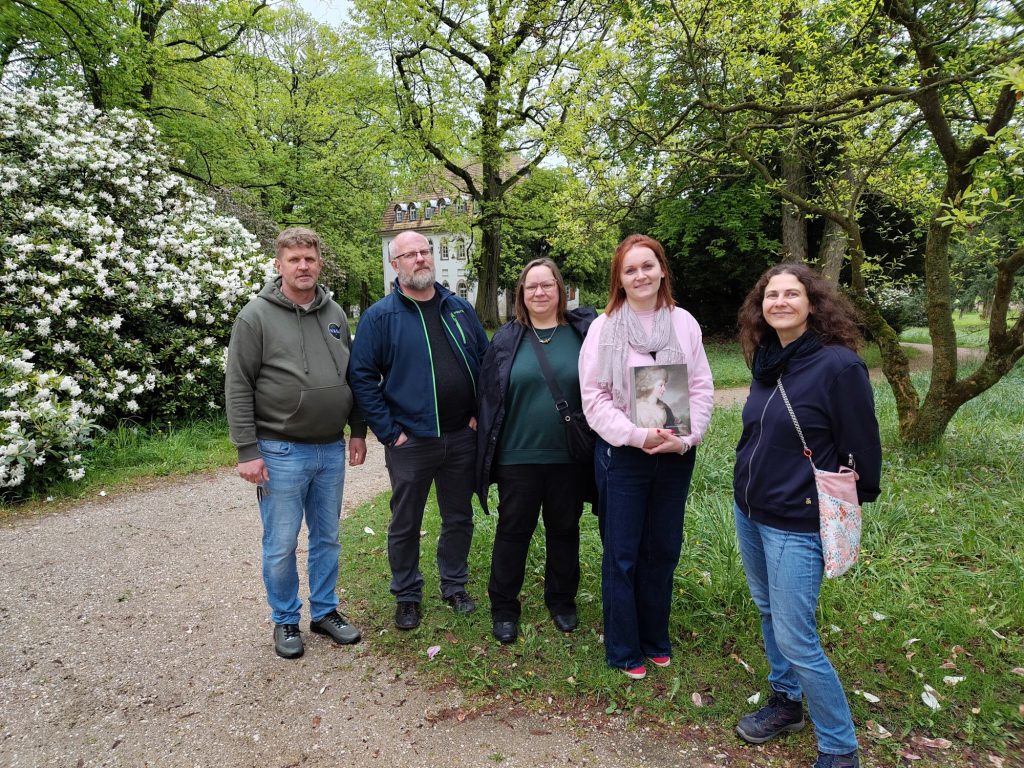
During the Duchess of Courland’s time, Tannenfeld Castle was only one-third of its current size and served as a summer residence for her daughters and family. Sensational cultural events to entertain the guests at Löbichau were also held at Tannenfeld under the Duchess’s direction. The final stop on the tour the following day was the Museum Burg Posterstein and its permanent exhibition on the Duchess of Courland’s salon.

The history of European salons, with a particular focus on the salon of Anna Dorothea of Courland, has been a key area of research and exhibition at the Museum Burg Posterstein for decades. Here you find further information.
A Duke with a Business Acumen
Duke Peter of Courland experienced all the ups and downs that can arise in a life under the absolute power of the Russian rulers: a glorious youth was followed by a period of exile with his father and, in 1795, his abdication—forced by the Russian crown—and the surrender of the Duchy of Courland. He had been Duke of Courland since 1769. Two marriages ended in childless divorce. He hoped to secure an heir through his marriage to Anna Dorothea von Medem in 1779.
His relationship with the Courland nobility was marked by ongoing conflicts. The ducal title granted him access to the most important European noble houses, particularly the royal court in Berlin. The Duke was regarded as a shrewd businessman and a patron of the arts. At his residence in Mitau, he gathered artists and scholars and founded an academic gymnasium. Even after his abdication, he remained one of the wealthiest men in Europe. He invested abroad early on to ensure the financial security of his wife and daughters. Among other things, he acquired real estate, such as Friedrichsfelde Castle in 1785 and the “Unter den Linden” city palace in Berlin. As early as 1786, he purchased the Duchy of Sagan with the express permission for female succession in view of his eldest daughter Wilhelmine, as well as the estates of Nachod and Ratiborschitz in Bohemia.

Löbichau and Tannenfeld belonged to his wife, Anna Dorothea, who was many years younger than him. During the summer months, she hosted distinguished guests here in her salon—including Russian Tsar Alexander I, Duke August of Saxe-Gotha-Altenburg, and the writers Theodor Körner, Jean Paul, and Johann Wolfgang von Goethe.
Research at the Museum Burg Posterstein
For nearly thirty years, the Museum Burg Posterstein has been conducting in-depth research into the history of Anna Dorothea of Courland; it is internationally renowned for its research work and maintains a nationwide network. For years, it has been in contact with the Latvian Rundāle Palace Museum. For example, the Museum Burg Posterstein initiated the traveling exhibition “Milestones in the Life of the Duchess of Courland” and connected the historical sites across Europe by bringing the exhibition, following its opening in Posterstein (2006), to Latvia (Rundāle Palace, 2008), Poland (Sagan Castle, 2009), and France (Valencay Castle, 2007).
By Marlene Hofmann / Museum Burg Posterstein