↓
 

Geschichte & Geschichten

Blog des Museums Burg Posterstein

Geschichte & Geschichten
  • Start
  • Burg Posterstein
  • Podcast LeseZEIT
  • Kinderburg
  • Salon Europa
  • Landschaft nach der Wismut
  • Weihnachtskrippen
  • English
  • Datenschutzerklärung
  • Impressum

Archiv der Kategorie: 19th century

The Welker Collection from Posterstein is heading to Courland

Geschichte & Geschichten Veröffentlicht am 13. Mai 2026 von Museum Burg Posterstein13. Mai 2026

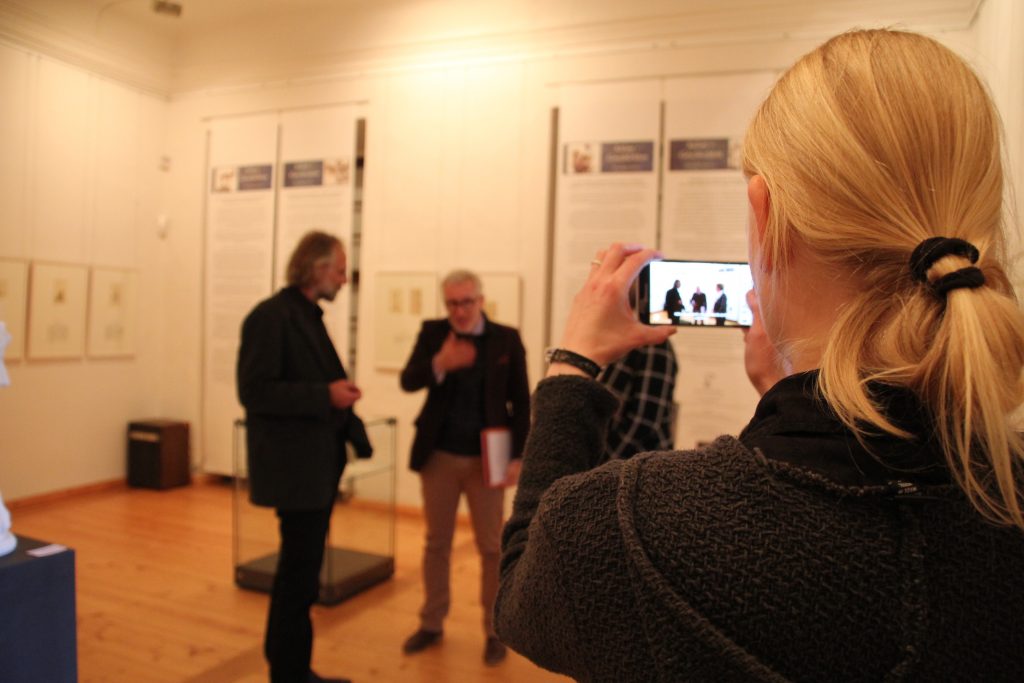
Guests from Courland, in present-day Latvia, visited the Altenburg region on May 7 and 8, 2026. They are working for the Rundāle Palace Museum. The palace of the Dukes of Courland is also known as the “Versailles of the North” and attracts hundreds of thousands of visitors each year. The Latvians came to pick up loans from Museum Burg Posterstein for a special exhibition. This is because parts of the Welker Collection from Posterstein will be on display this summer at Mežotne Palace, the birthplace of Duchess Anna Dorothea of Courland. The exhibition “The Court of the Muses. The Salon of Duchess Dorothea of Courland at Löbichau Palace in the Caricatures of Ernst Welker” will be on view from June 5 to September 3, 2026.

The Duchess as a Poodle?

Ernst Welker’s caricatures depict the Duchess, her daughters, and her guests as hybrid creatures, each accompanied by a humorous rhyme. It is likely that Welker, as the art teacher of the Duchess’s granddaughter, presented the drawings in the salon, and that the Duchess had enough of a sense of humor to allow him to portray her as a loyal poodle.

Der Maler Ernst Welker stellte die schöne Herzogin als Pudel dar. Der französische Diplomat Talleyrand schrieb ihr hunderte von Briefen.
The painter Ernst Welker depicted the beautiful duchess as a poodle.

The exhibition is curated by the Rundāle Palace Museum, with which the Posterstein Museum team has maintained a relationship for decades. At the end of this exhibition, Franziska Huberty and Marlene Hofmann, staff members at the Museum Burg Posterstein, will travel to Latvia to give a lecture on Löbichau, Tannenfeld, and Posterstein Castle.

The caricatures from the Welker Collection have been digitized and can be viewed in the German Digital Library and in the European online library Europeana (link to the Welker Collection).

Visiting Tannenfeld, Löbichau, the church in Großstechau, and Posterstein Castle

During their visit to the Altenburg region, the Posterstein museum team, with the support of the Großstechau parish, first guided their colleagues from Courland through the local church. Großstechau Church was the private chapel of Anna Dorothea of Courland. She had a VIP box there, and her funeral was also held here.

Blick auf die herrschaftliche Loge der Herzogin von Kurland in der Kirche Großstechau
From the gallery, you can see the Duchess of Courland’s box in the church in Großstechau.

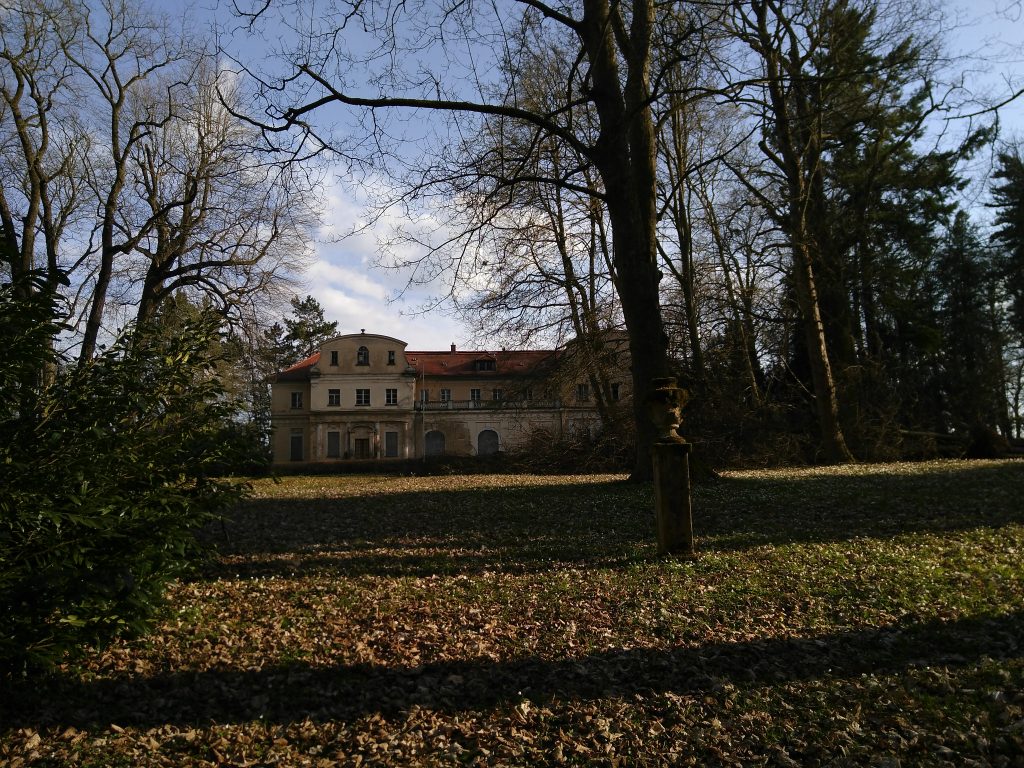
The tour group then viewed Löbichau Castle—which the duchess had expanded based on the design of her birthplace, Mesothen Castle, and which no longer exists in its original form—from the outside, and continued on to Tannenfeld.
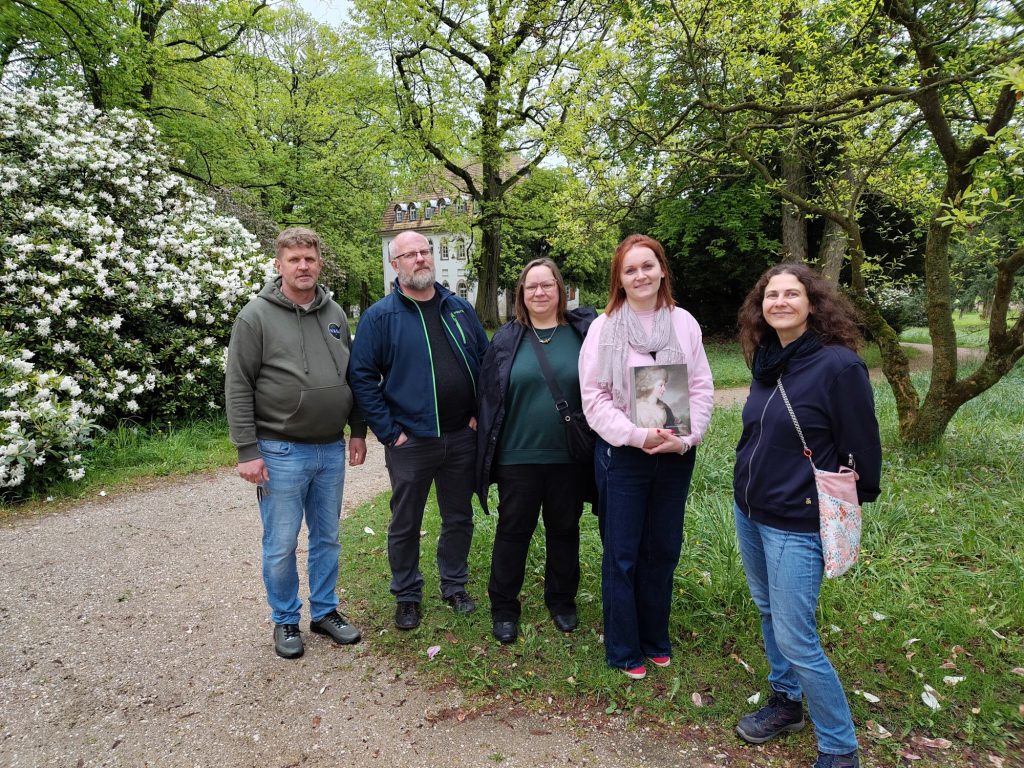
Fünf Menschen stehen im Schlosspark Tannenfeld, im Hintergrund blühen Rhododendren
The Latvian museum staff and Marlene Hofmann from the Museum Burg Posterstein in Tannenfeld Castle Park.

During the Duchess of Courland’s time, Tannenfeld Castle was only one-third of its current size and served as a summer residence for her daughters and family. Sensational cultural events to entertain the guests at Löbichau were also held at Tannenfeld under the Duchess’s direction. The final stop on the tour the following day was the Museum Burg Posterstein and its permanent exhibition on the Duchess of Courland’s salon.

Zwei Frauen in der Postersteiner Ausstellung zur europäischen Salongeschichte
Sabine Hofmann from the Museum Burg Posterstein (left) with Līva Daniniece, Head of the Collections and Research Department at the Rundāle Palace Museum, during expert discussions on research into the Duchess of Courland at the Posterstein exhibition.

The history of European salons, with a particular focus on the salon of Anna Dorothea of Courland, has been a key area of research and exhibition at the Museum Burg Posterstein for decades. Here you find further information.

A Duke with a Business Acumen

Duke Peter of Courland experienced all the ups and downs that can arise in a life under the absolute power of the Russian rulers: a glorious youth was followed by a period of exile with his father and, in 1795, his abdication—forced by the Russian crown—and the surrender of the Duchy of Courland. He had been Duke of Courland since 1769. Two marriages ended in childless divorce. He hoped to secure an heir through his marriage to Anna Dorothea von Medem in 1779.

His relationship with the Courland nobility was marked by ongoing conflicts. The ducal title granted him access to the most important European noble houses, particularly the royal court in Berlin. The Duke was regarded as a shrewd businessman and a patron of the arts. At his residence in Mitau, he gathered artists and scholars and founded an academic gymnasium. Even after his abdication, he remained one of the wealthiest men in Europe. He invested abroad early on to ensure the financial security of his wife and daughters. Among other things, he acquired real estate, such as Friedrichsfelde Castle in 1785 and the “Unter den Linden” city palace in Berlin. As early as 1786, he purchased the Duchy of Sagan with the express permission for female succession in view of his eldest daughter Wilhelmine, as well as the estates of Nachod and Ratiborschitz in Bohemia.

Durch zwei Türen fotografiert die Räume zur europäischen Salongeschichte im Museum Burg Posterstein
The Burg Posterstein Museum has dedicated three exhibition rooms to the history of European salons, using the salon of the Duchess of Courland as an example.

Löbichau and Tannenfeld belonged to his wife, Anna Dorothea, who was many years younger than him. During the summer months, she hosted distinguished guests here in her salon—including Russian Tsar Alexander I, Duke August of Saxe-Gotha-Altenburg, and the writers Theodor Körner, Jean Paul, and Johann Wolfgang von Goethe.

Research at the Museum Burg Posterstein

For nearly thirty years, the Museum Burg Posterstein has been conducting in-depth research into the history of Anna Dorothea of Courland; it is internationally renowned for its research work and maintains a nationwide network. For years, it has been in contact with the Latvian Rundāle Palace Museum. For example, the Museum Burg Posterstein initiated the traveling exhibition “Milestones in the Life of the Duchess of Courland” and connected the historical sites across Europe by bringing the exhibition, following its opening in Posterstein (2006), to Latvia (Rundāle Palace, 2008), Poland (Sagan Castle, 2009), and France (Valencay Castle, 2007).

By Marlene Hofmann / Museum Burg Posterstein
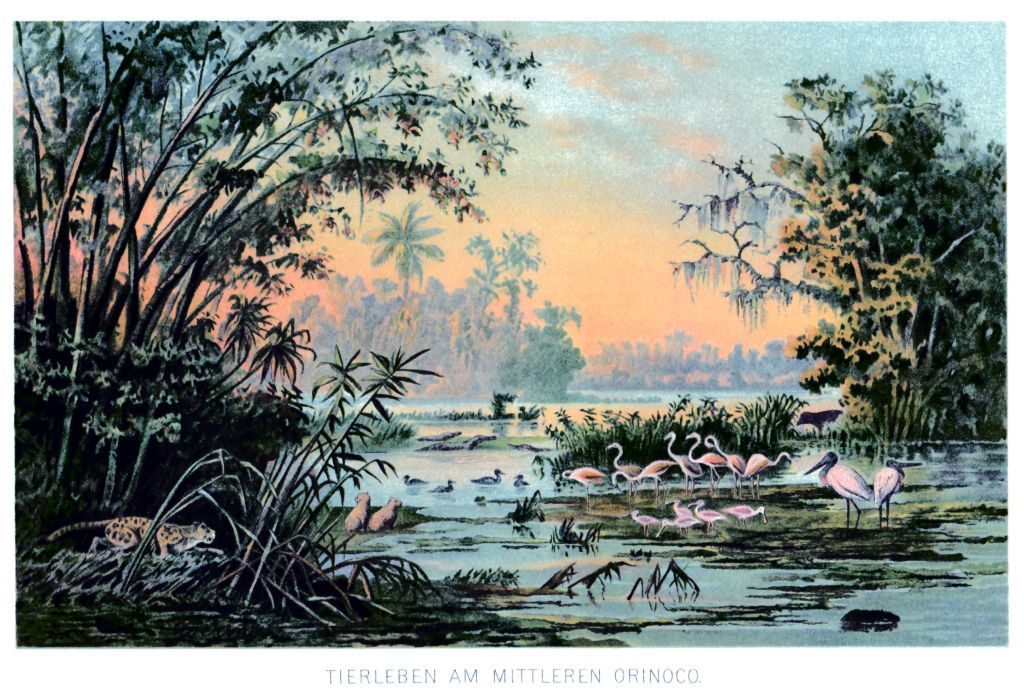
Exploring South America: The ornithologist and painter Anton Goering

Geschichte & Geschichten Veröffentlicht am 25. Juni 2019 von Museum Burg Posterstein16. Dezember 2022
Animal life at the middle Orinoco, chromolithographie after Anton Goering’s sketch, collection Museum Burg Posterstein

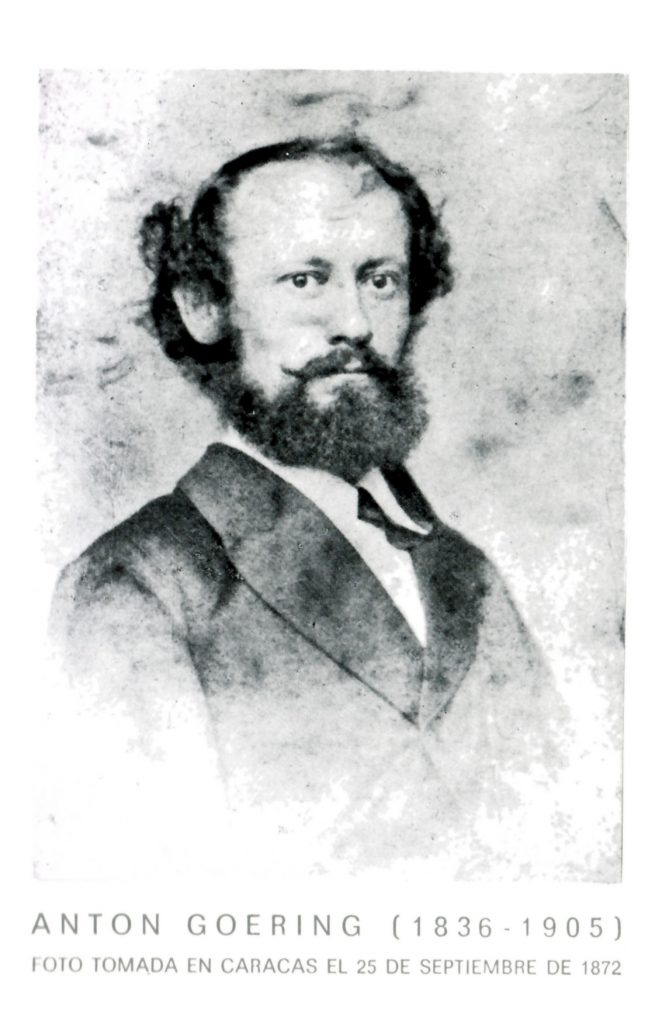
Although Christian Anton Goering (1836-1905) was the son of a craftsman he succeeded in a career as an explorer, painter and animal preparator. Like Humboldt before he went on two expeditions to South America (1856 and 1866) and conducted botanical and geographic studies.  

Anton Goering: Impressive landscape in the south of Lake Maracaibo, from the book „Venezuela“, Collection Museum Burg Posterstein

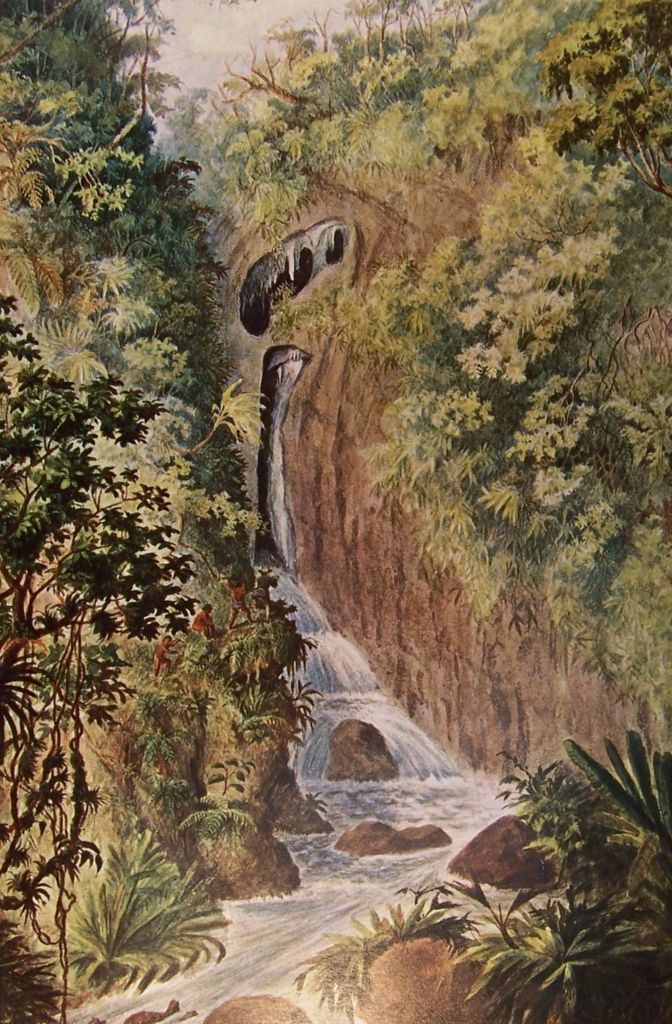
On his first journey he worked as assistant and companion of the well-known german scientist Hermann Burmeister. On the second one Goering ventured on behalf of the Zoological Society of London. He collected rare animals for the collection of the Natural History Museum, did preparations and captured his impressions of the landscape in pictures, painted in watercolor. With his work, Anton Goering made an important contribution to the study of Venezuela. Amongst other things, he discovered the up to then unknown caves at Caripe. In 1893 he published his travel impressions in Leipzig under the title: „Vom tropischen Tieflande zum ewigen Schnee, Eine malerische Schilderung des schönsten Tropenlandes Venezuela“.

Anton Goering and his way to South America

Christian Anton Goering was born on 18. September 1836 in Schönhaide in today’s Altenburger Land. His father, a craftsman, was a member of the regional society for ornithology and so his son, too, found his interest for nature. He studied in the school of arts of Bernhard von Lindenau in Altenburg, 20 kilometres from Schönhaide. Later he worked as preparator and conservator in the zoological museum of the University of Halle. His professor was Dr. Hermann Burmeister. Amongst others Christian Ludwig Brehm, and his son Alfred Brehm gave Goering natural scientific advice.  

Portrait of Anton Goering, from the book „Venezuela“, Collection Museum Castle Posterstein

The first expedition to South America (1856-1858)

Anton Goering gained his first travel experiences as a companion of Hermann Burmeister. For over two years they explored the flora and fauna of Brazil, Argentina and Uruguay.

In September 1856 Goering traveled from Halle to Hamburg, where he met with Burmeister and his son. Goering and the young Burmeister left Hamburg on the sailing ship “Dorothea” on September 29 with the destination Rio de Janeiro. Hermann Burmeister, the leader of the expedition, took another ship. After almost six weeks they reached the coast of South America.

On December 1, 1856, the journey started in Rio de Janeiro.  Over two years the group traveled to Montevideo, San José, and Mercedes. In 1858 Goering took a ship back to Germany.

The second expedition to South America (1856-1858)

Through his patron Philip Lutly Sclater, secretary of the Zoological Society of London, Anton Goering got the opportunity to take a field trip to South America as a corresponding member of the Zoological Society of London, in 1866.

His main destination was Venezuela, where he collected bird skins for the British Museum (Natural History Museum) and explored the country’s flora.

On September 18, 1866, he left London on a steamship and reached the port of Carupano (via Trinidad) on September 30. For eight years, Anton Goering researched and painted the landscape and the flora and fauna of Venezuela. He discovered the up to then unknown caves at Caripe and sent collected bird and animal skins to the British Museum.

Anton Goering: The Caripe Caves in the state of Monagas, East Venezuela, from the book „Venezuela“, Collection Museum Burg Posterstein

In 1868 Dr. Sclater published Goerings collections in an article in the journal „Proceedings of the Zoological Society of London„. A first collection contained 173 skins, collected at Carupano, Pilar, and Caraccas. Three of the birds were described as being probably new to science. A second collection contained specimens of 99 species, the most of them Venezuelan birds.

In 1874 Goering left South America and took a ship back to Germany.

Later, in 1893, Anton Goering published his travel impressions of this secondexpedition to Venezuela in his book: „Vom tropischen Tieflande zum ewigen Schnee, Eine malerische Schilderung des schönsten Tropenlandes Venezuela“.

The later years

Since 1874 Goering worked as an animal and landscape painter in Leipzig. Together with other artists, he made the illustrations for „Brehms Tierleben“ (Brehm’s Animal Life).

He remained in contact with the Altenburg naturalists for life. So he was appointed an honorary member of the “Naturforschende Gesellschaft des Osterlandes zu Altenburg” and the Ornithological Society of Leipzig. Duke Ernst I. of Saxony-Altenburg awarded him the title of Professor for his services. Anton Goering died on December 7, 1905, in Leipzig.

By Franziska Engemann / Museum Burg Posterstein


In 2019 we celebrated the 250th birthday of Alexander von Humboldt. The well-known scientist and researcher inspired not only his contemporaries to do traveling and researching all over the world, but also later generations until today. That’s why we prepared an exhibition on Anton Goering (1836-1905).

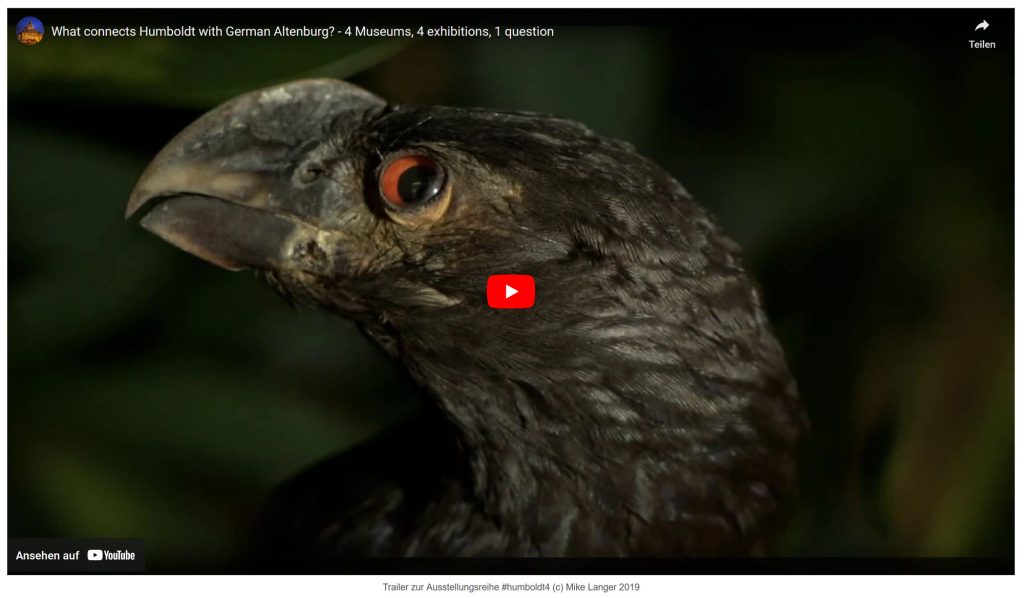
Ein Vogel in Großaufnahme - Thumbnail zum Trailer für die Ausstellungsreihe humboldt4 (c) Mike Langer 2019
Den Trailer für die Ausstellungsreihe humboldt4 ((c) Mike Langer 2019) kann man auf YouTube ansehen.

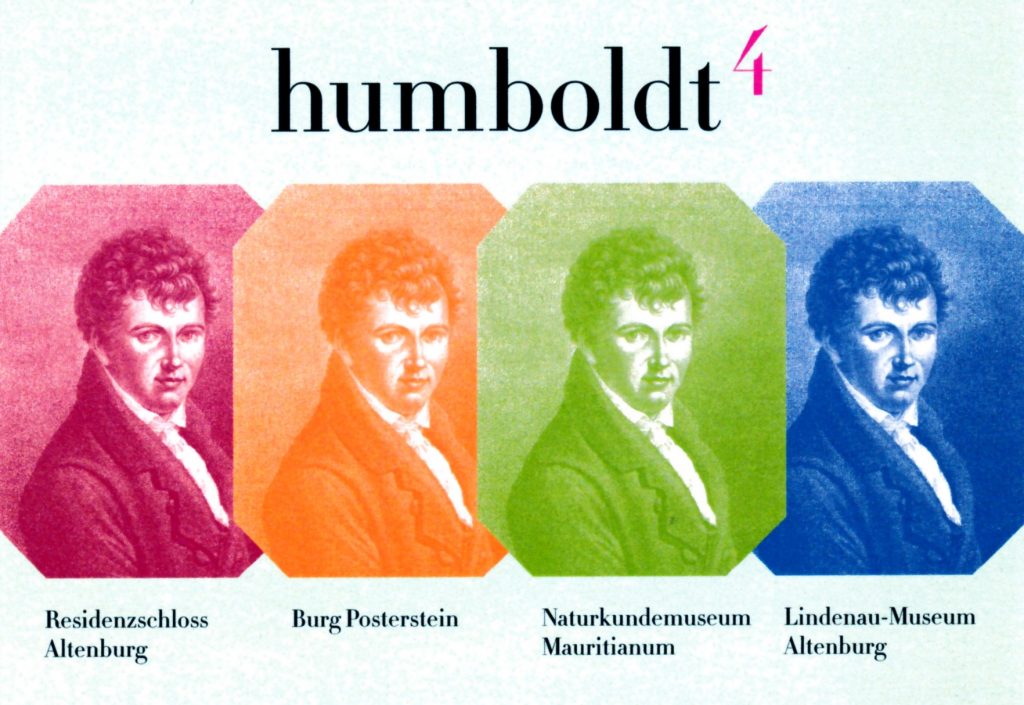
For this event four museums of the county Altenburger Land in Thuringia, Germany – Lindenau-Museum Altenburg, Residence castle Altenburg, Museum of Natural Science Mauritianum and Museum Burg Posterstein – presented special exhibitions about Humboldt and his influence on the region together under the title: #humboldt4.

In Museum Posterstein Castle we commemorated the illustrator Christian Anton Goering (1836-1905).

The exhibition at Museum Posterstein Castle followed Goering’s progress and life from Altenburger Land, Germany, to South America. His journeys are revived in his diaries and woodcuts, loans from the Leibniz Institute for Regional Geography in Leipzig (Leibniz Instituts für Länderkunde). Exotic animals prepared by Anton Goering put a picture of the research expeditions in the footsteps of Alexander von Humboldt across to the visitors.

#differenceMW: Networking then and now – Europe means to me …?

Geschichte & Geschichten Veröffentlicht am 29. April 2018 von Museum Burg Posterstein29. April 2018

In 1815, after the disastrous Napoleonic Wars, the Congress of Vienna brought decades of peace and stability to Europe. By comparison, this can also be said of the European unification, the political change in 1989 and the overcoming of European division after World War II. After the euphoria of the 1990s, when Europe stood for growth and stability in the eyes of many citizens, the situation changed at the latest with the 2007-08 financial crisis. Today it seems, that under the influence of terror, refugee crisis and populism, scepticism towards Europe prevails. To make matters worse, many equate the European project with crusted bureaucratic EU structures. At the last day of this year’s #MuseumWeek with the subject #differenceMW we want to write about  different views on Europe, today and back then – and about a very experimental exhibition project.

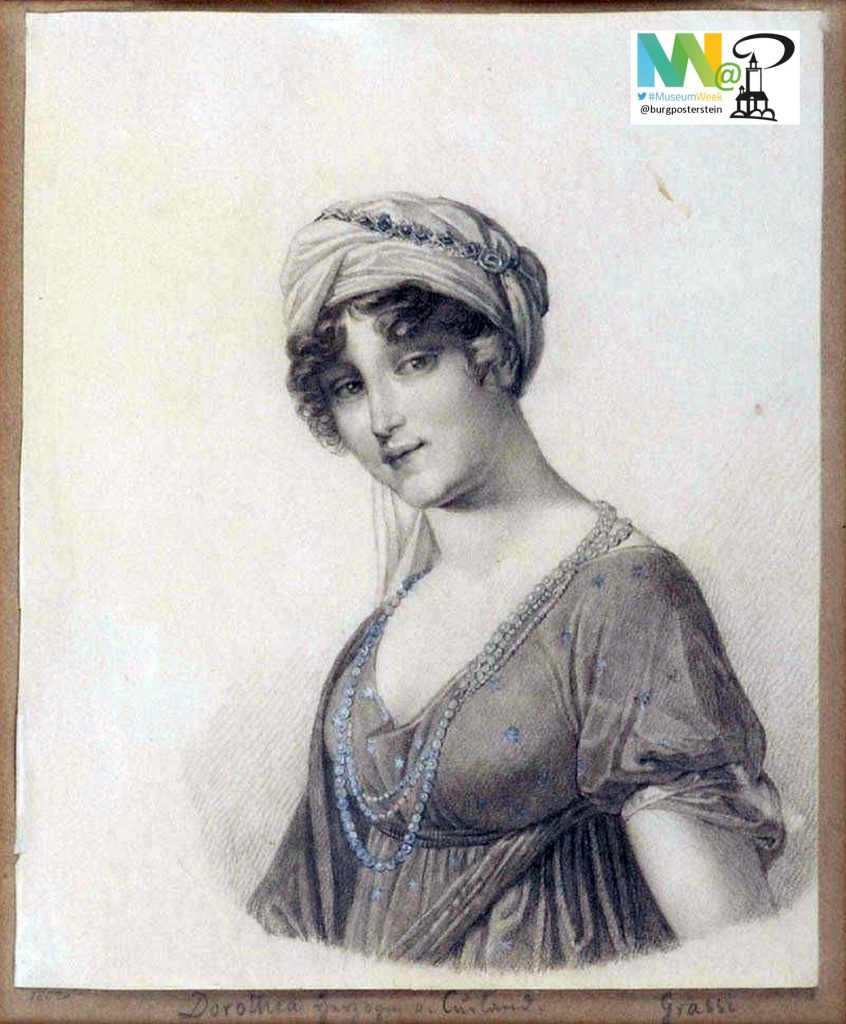
Auch in der Zeit zwischen Aufstieg und Fall Napoleons und Wiener Kongress befand sich Europa im Umbruch. Ein Portrait Anna Dorothea von Kurlands, von Grassi.

Even in the period between the rise and fall of Napoleon and the Congress of Vienna, Europe was in transition. A portrait of Anna Dorothea of Kurland, by Grassi.

Visions are needed to give Europe an identity for its citizens and the ability to act in the world, because we are living in Europe and have to get along with each other, whether we like it or not.

Towards the end of the last century, the Balkan wars demonstrated vividly, how quickly peace can be lost inside a union or a single country.

So everyone should contribute to politics, economics, art, culture. Only when dialogue takes place with respect for other opinions can future-oriented solutions be found. Communication needs proximity and proximity has to be promoted. The salon had this human proximity and holds the potential to achieve it today. Let’s pick up the salon culture actively and transport it into here and now.

Anna Dorothea of Courland – a confident European woman

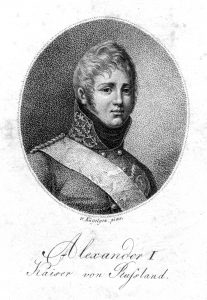
Tsar Alexander I. came to Löbichau in 1808.

Tsar Alexander I. came to Löbichau in 1808.

Between 1795 and 1821 relationships had been established over European borders in the small Thuringian villages of Löbichau and Tannenfeld. Two centuries ago, the beautiful and educated Duchess Anna Dorothea of Courland (1761-1821) headed a famous salon and, together with her daughters, establishing a network of contacts into the highest political circles of Europe. Amongst others, her network partners included Tsar Alexander I. (1777-1825), Friedrich Wilhelm III. (1770-1840), Talleyrand (1754-1838) and Metternich (1773-1859). The network reached from Löbichau out to St. Petersburg, Warsaw, Berlin, Paris, Rome and Vienna, to Russia, Poland, France, Italy and Denmark.

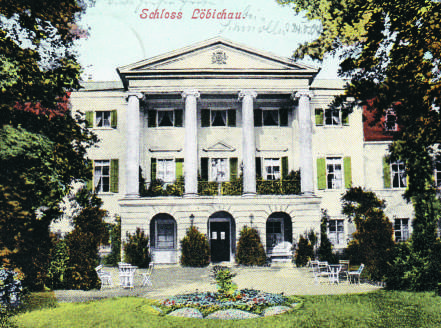
Schloss Löbichau, Ansichtskarte von 1904 (Museum Burg Posterstein)

Löbichau Castle, postcard from 1904 (Museum Burg Posterstein)

This salon of encounter and exchange was one of the most famous of its kind at the beginning of the 19th century. In this salons, often led by a lady, contacts were made and political decisions were initiated – accompanied by music, theater and tea, salons were one of very view possibilities for women to participate in society. Countless letters document this time. If people like Anna Dorothea of Courland would have had the possibilities of today’s social media, they certainly would have been among the „influencers“ of their time.

The exhibition “#SalonEuropa analog meets digital“

The exhibiton is designed as a laboratory. Based on the historic salon culture around 1800, it is supposed to create a relation to the present time and current political situation. As the poet Jean Paul acknowledged, everyone in the salon of the Duchess of Courland was free to express his opinion as long as it was presented in a courteous manner.

Die Ausstellung #SalonEuropa: Vor Ort und digital versteht sich als Labor. Besuchern und uns selbst stellen wir die Frage: Was bedeutet Europa für uns selbst?

We see the exhibition #SalonEuropa: Networking then and now – Europe means to me …?  as a laboratory. We ask the question: what does Europe mean to us?

Similarly, visitors of the #SalonEuropa Laboratory will be given the opportunity to express their thoughts on Europe today, both in analog and digital form. A screen in the exhibition and the exhibition’s website display different opinions on Europe in videos, commentaries and blog posts. Comments can be entered directly in the exhibition and will be visible on the Internet after approval. We aim to bring together as many opinions as possible on the website, which in this way are visible in the exhibition.

We are looking for opinions and photos of Europe for the exhibition!

Pictures and photographs of European places and cities around 1800 and today (in Latvia, Poland, Austria and France) will connect the exhibition to the There and Now. On a work table plans for a centre of historic salon culture at Posterstein Castle will be shown. Several events will accompany the ehibition.

We are looking for photos of European places today and people who express their opinion on the question „Europe means for me …?“, which would be represented in the exhibition in one form or another. Feel free to contact us on the social networks, by mail or in person.

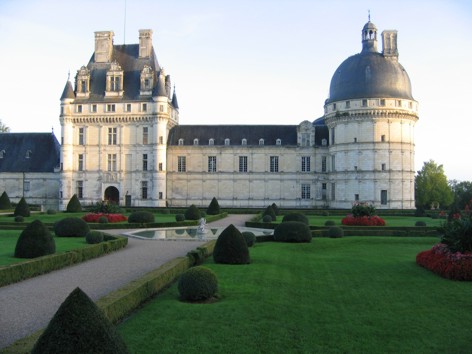
Über ein Vierteljahrhundert wetteiferte alles, was in Europa Rang und Namen hat, darum, vom illustren Diplomaten Talleyrand in Valençay empfangen zu werden. Nach dem Wiener Kongress und der Rückkehr der Bourbonen zog sich Talleyrand mit der jüngsten Tochter der Herzogin von Kurland, Dorothée, auf Schloss Valençay zurück.

Historical and present-day views of places in Europe are to play a role in the exhibition #SalonEuropa – for example Castle Valençay, France: For 200 years ago important people in Europe competed to be received by the illustrious diplomat Talleyrand in Valençay. Following the Congress of Vienna and the return of the Bourbons, Talleyrand retired to Castle Valençay with the Duchess of Courland’s youngest daughter Dorothée.


By Klaus Hofmann, translation: Franziska Engemann / Museum Burg Posterstein

A minister close to nature – Hans Wilhelm von Thümmel

Geschichte & Geschichten Veröffentlicht am 28. April 2018 von Museum Burg Posterstein11. Mai 2020

A special part of the permanent exhibition of Museum Posterstein Castle tells the story of the minister Hans Wilhelm von Thümmel (1744-1824). This remarkable man was a friend oft he Duchess Anna Dorothea of Courland (1761-1821)  and regular guest at her castles in Löbichau and Tannenfeld. Here we present Hans Wilhelm von Thümmels gardens.

As head of goverment Hans Wilhelm von Thümmel was one oft he most famous persons in the Altenburg part of the duchy Saxony-Gotha-Altenburg. And a minister close to nature. As a confidant of the Gotha Dukes, he represented the duchy as a diplomat in Paris, Berlin, Vienna and Denmark. He initiated the geodetic surveying of the duchy and left behind a comprehensive landscape heritage. But often it did not last.

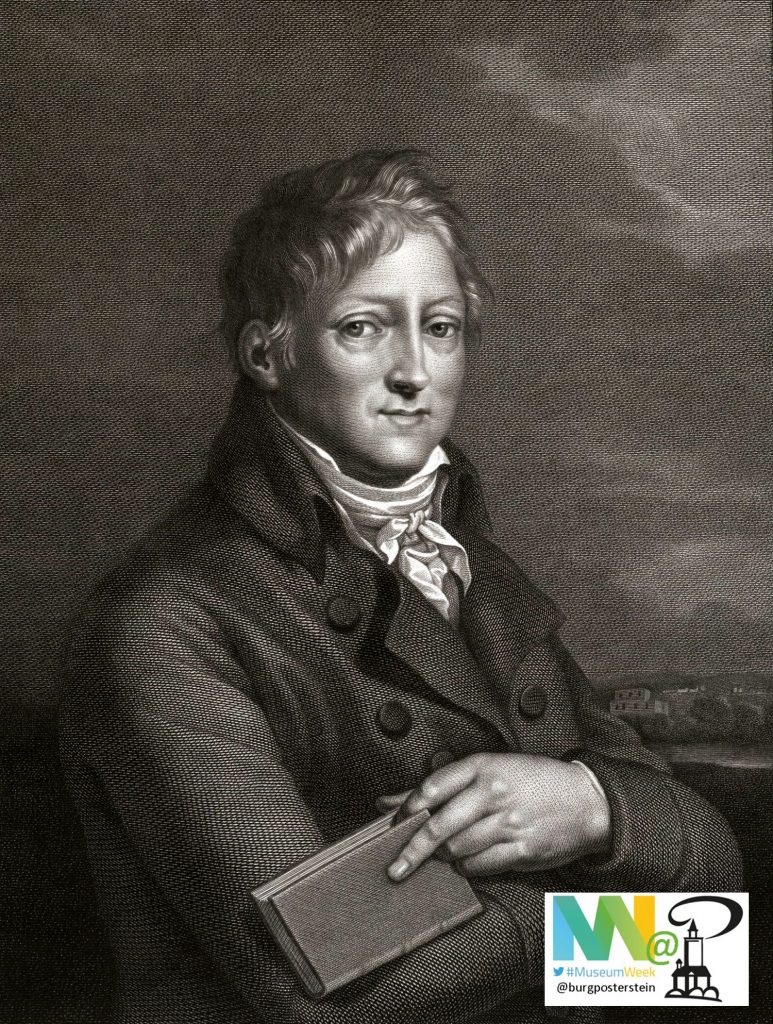
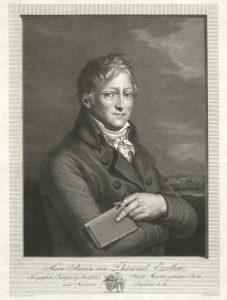
Der Sachsen-Gotha-Altenburgische Minister Hans Wilhelm von Thümmel (Museum Burg Posterstein)

Hans Wilhelm von Thümmel, minister in the duchy Saxony, Gotha and Altenburg (Museum Burg Posterstein)

His harmony with nature can be guessed not only at his extraordinary and beautiful tomb: the 1000-year-old oak in Nöbdenitz. It can be guessed at his horticultural heritage: for example Thümmel’s private English garden with a palace in Altenburg, his manors in Nöbdenitz and Untschen, the “Polish cottage” in Münsa, or the palace garden in Altenburg.

These gardens were not only seen as places of recreation and entertainment in the countryside, but also as educational establishment: as gardens of the Enlightenment.

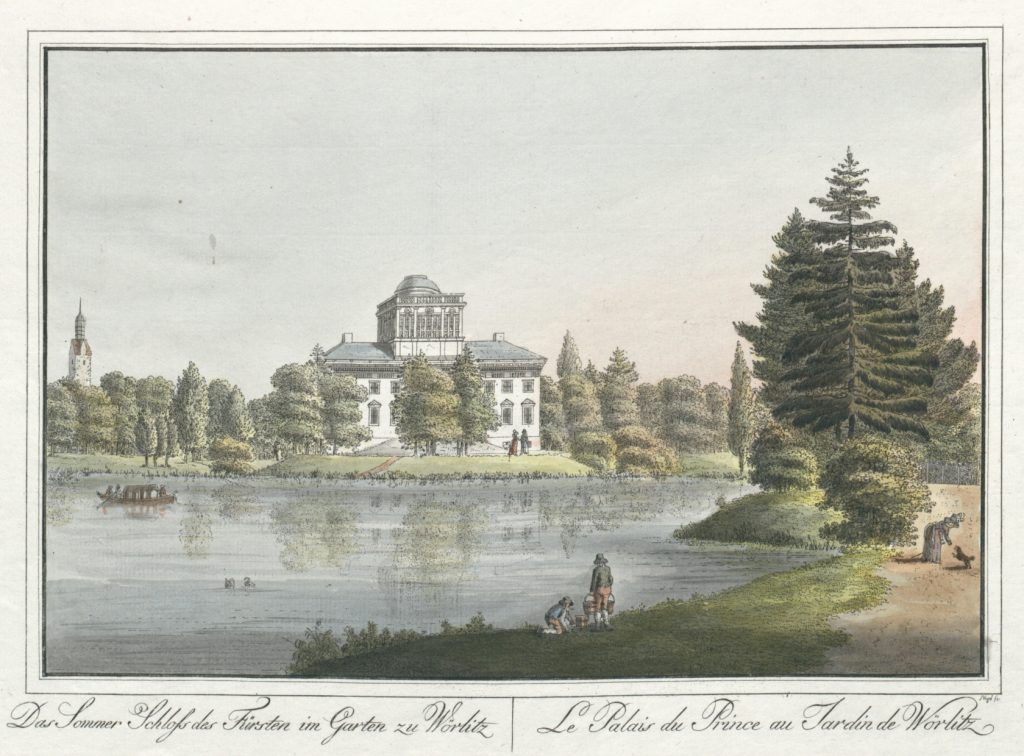
Das Sommer Schloss des Fürsten im Garten zu Wörlitz. Le Palais du Prince au Jardin de Wörlitz | Nagel, Johann Friedrich (Public Domain, Österreichische Nationalbibliothek).

Le Palais du Prince au Jardin de Wörlitz | Nagel, Johann Friedrich (Public Domain, Österreichische Nationalbibliothek).

Thümmel’s private English garden in Altenburg

At the beginning of the 19th century, the garden of Hans Wilhelm von Thümmel was considered as one of the most important sights of Altenburg. In its final extension, the long park ground was enclosed by a wall with seven gates. At the highest point of the site, with the best view of Altenburg, Thümmel had a villa built in 1788 in the style of Italian classicism.

The park had artificial grottoes, streams and ponds. Small pleasure houses in different styles as well as the so-called „Kachelhaus“ – or „Turkish Pavilion“ – were integrated into the concept. The well-known artist Adrian Zingg captured the beauty of the Thümmel garden for eternity in his pictures.

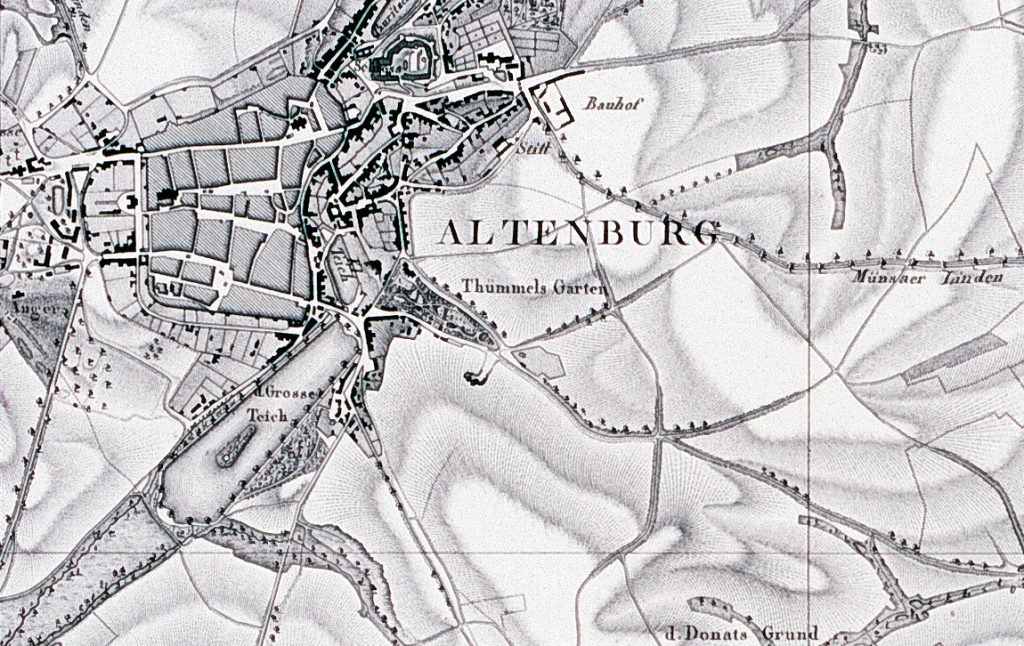
Thümmels Garten in Altenburg auf der Thümmelschen Karten von 1813, Section VIII.

Thümmel’s garden in Altenburg on the Thümmel map from 1813, section VIII.

As Thümmels legacy the garden did not last long. Several decades after his death in 1824 the garden had been greatly reduced by Thümmels heirs by selling several areas. Today, only the preserved central building of the palace reminds of its former glory.

The palace garden in Altenburg

In addition to the design of his private garden in Altenburg Hans Wilhelm von Thümmel was also involved in the transformation of the palace park Altenburg from baroque to landscaped grounds.According to reports of the Altenburger Chronicler Christian Friedrich Schadewitz (1779-1847), the chamber president Thümmel had already 1784/86 removed yew tree figures as well as the hedged. The open spaces were laid out with grass and a new orangery was placed on it. Around 1800, the first tulip trees were planted and formed the foundation for today’s English Park of Altenburg Castle.

Nöbdenitz manor – Thümmels old-age residence

Hans Wilhelm von Thümmel came into the possession of the manors Nöbdenitz and Untschen by marriage.Especially the park around the estate Nöbdenitz with its romantic hermitage met with universal approval. In 1782, Thümmel’s father-in-law and predecessor in office, Johann von Rothkirch und Trach (1710-1782), had the old Nöbdenitz castle renovated and a new mansion built, as well as a mausoleum as family grave. Thümmel chose this peaceful place as his old-age residence.

For sailing on the pond of Nöbdenitz manor

Nöbdenitz is very close to the castles Löbichau and Tannenfeld, in which the duchess Anna Dorothea of Courland invited guests to her well-known salon. But also visits by the Duchess and her guests in Nöbdenitz at Thümmels house were usual events. Here they met to sail on the large pond of the manor and took walks to the 1000-year-old oak, which Thümmel had chosen as his future grave.

Schloss und Herrenhaus Nöbdenitz - Hans Wilhelm von Thümmel legte hier einen weitläufigen englischen Garten an mit Bächlein und "Einsiedeley" (Lithografie: Museum Burg Posterstein).

Castle and manor house in Nöbdenitz – Hans Wilhelm von Thümmel had an english garden (lithografie: Museum Burg Posterstein).

The surrounding park extended east of the 1782 built „New Manor House“ whose perron led down to the garden. A little brook – the “millrace” – flowed through the park. Figures or rondels had been placed at partings of the way.  From the main way three bridges led over the millrace into the landscape on the south side, which was enclosed by a wood. A hermitage had been built next to the weir at the millrace. It was a popular motif in the gardens of the Enlightenment. The hermitage was a quiet place of contemplation amidst nature, a place where one be able to communicate with oneself, nature and God. This hermitage in Nöbdenitz was also pictured by the engraver Zingg. The building itself doesn’t exist anymore.

A „Chinese bathhouse“ and a „Polish cottage“

Also the redesign of Untschen manor including the establishment of a bathhouse in the Chinese style or the creation of the destination „Polish cottage“ in Münsa were realized under Thümmels direction. But he was not the only one who appreciated and promoted the local garden art. The much-admired duchess Anna Dorothea of Courland, also belonged to this circle.

Der Schlossprk in Tannenfeld im Frühjahr 2018.

The english garden in Tannenfeld in spring 2018.

Tannenfeld – pleasure garden in the English style

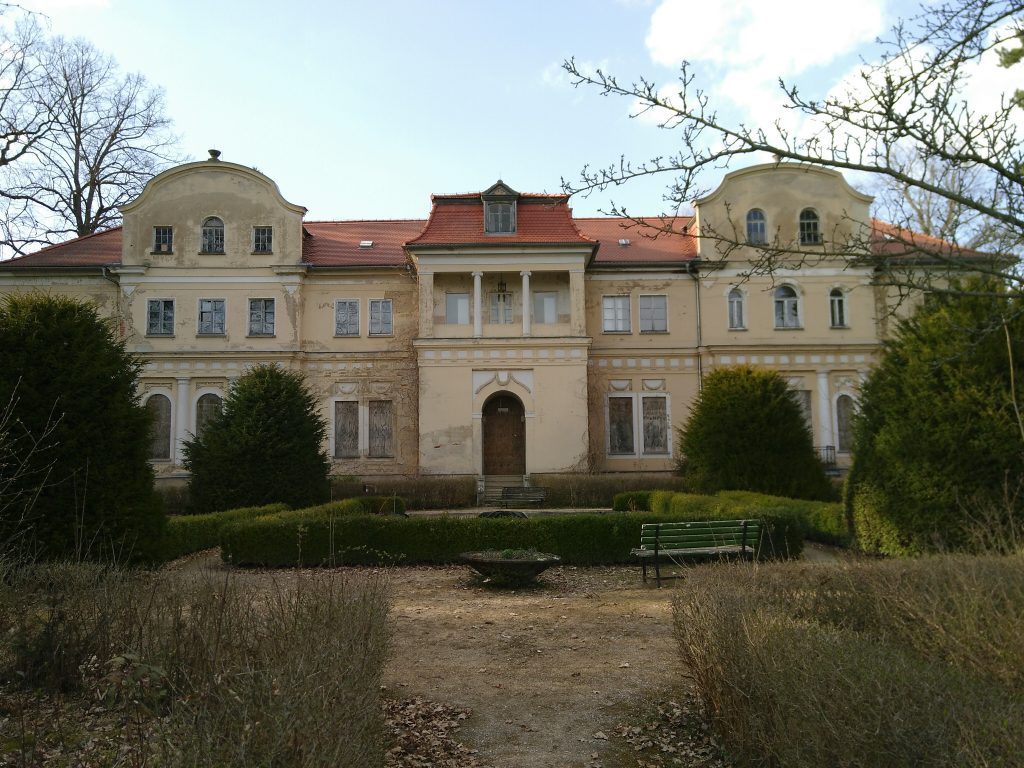
Contemporaneous with the building of Tannenfeld Castle also the development of Tannenfeld park started under the direction of the Duchess of Courland. The new building, with a beautiful view to Posterstein Castle, was embedded in the new landscape park. At the time of Anna Dorothea of Courland Tannenfeld was about half an hour away from Löbichau.

Schloss Tannenfeld im Frühjahr 2018 (Foto: Marlene Hofmann):

Tannenfeld Castle in spring 2018 (Foto: Marlene Hofmann):

If the visitors turned from the main road between Ronneburg and Schmölln to Tannenfeld, they passed a small gatehouse and through an alley lined with Italian poplars they came to park and castle. Sandy paths led the walkers past groups of trees or shrubs and sentimental-romantic memorial stones. One stone was bearing the inscription “Peterswiese” and reminded of the 1800 deceased husband of Dorothea of ​​Courland. A narrow stream flowed through the meadow and ended in a pond. On an island in the pond there was the so-called „Hermitage“, a grotto formed of rocks.

By Franziska Engemann, Christiane Nienhold und Marlene Hofmann, translation: Franziska Engemann, Matthias Huberti / Museum Burg Posterstein

#WomenMW: The Lady behind the pseudonym „Ernst Ritter“

Geschichte & Geschichten Veröffentlicht am 23. April 2018 von Museum Burg Posterstein20. April 2018

On the first day of this year’s international #MuseumWeek women take centre stage. The Hashtag #WomenMW leads us to Löbichau Castle and Tannenfeld Castle near Posterstein. Between 1795 and 1821 there was a living salon in both castles. The hostess was the beautiful duchess Anna Dorothea of Kurland (1761–1821), one of the most impressive salonniéres of her time. But also among her guests in Löbichau, important women can be found – like Emilie von Binzer.

Der Salon der Herzogin von Kurland in Schloss Löbichau zählte zu den bekanntesten seiner Art.

The salon of the Duchess of Courland was one of the most famous of its kind at the beginning of the 19th century.

With the 18th century Parisian salons, where members of the court, scholars and artists met, a culture emerged during the Enlightenment, spreading throughout Europe. At the end of the 18th century Löbichau Castle became such a center of intellectual and cultural life in Germany. The salon of the Duchess of Courland was one of the most famous of its kind at the beginning of the 19th century.

How a box came from the estate of Emilie von Binzer to Posterstein Castle

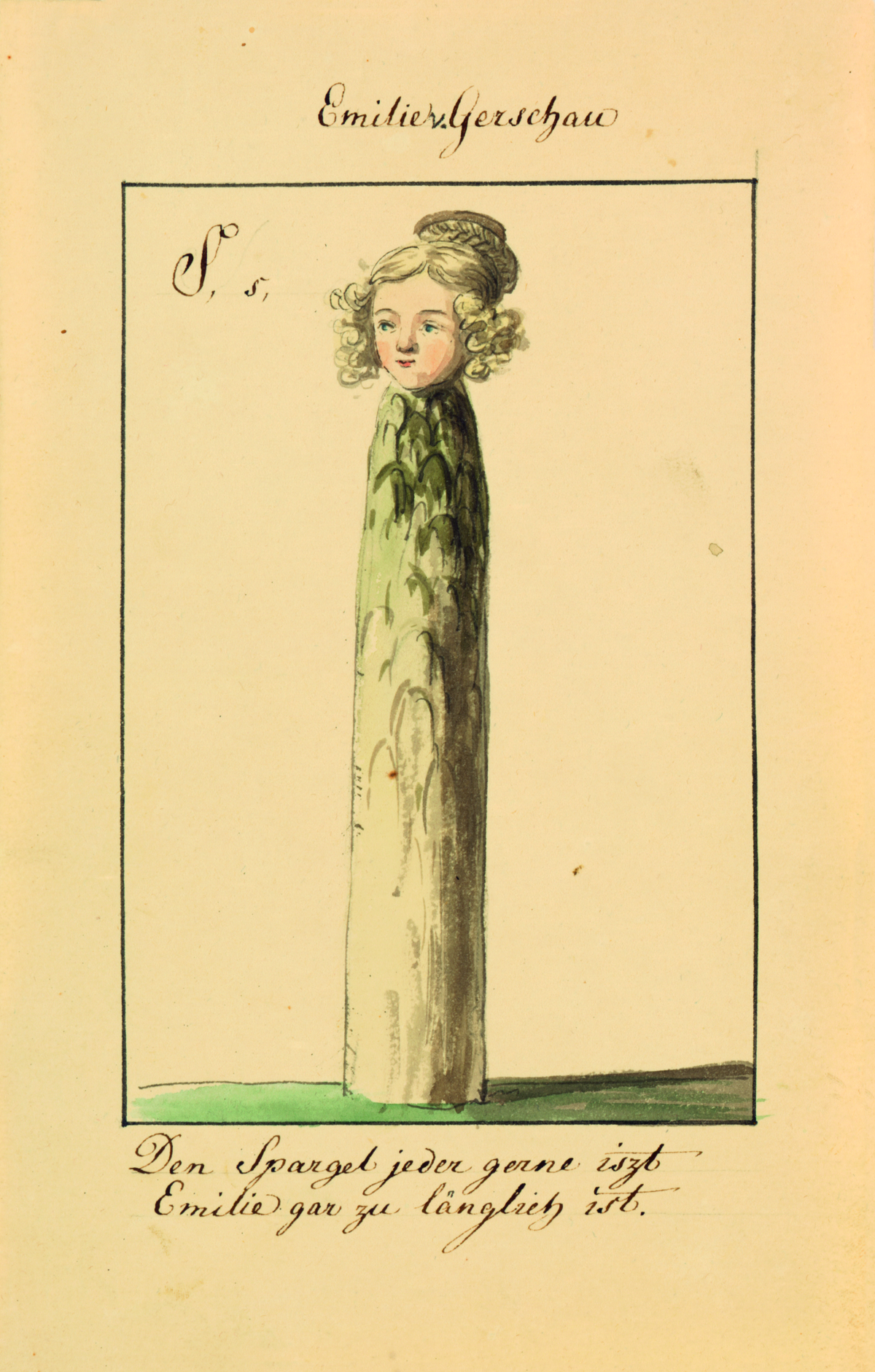
In 2014 the Museum Posterstein Castle – promoted by financial resources of the Free State of Thuringia and from Bürgerstiftung Altenburger Land – could purchase a unique collection of portrait drawings. The 47 watercolored drawings date back to 1819/20 and represent the guests in the salon of the Duchess of Courland as mythical creatures. The unique pieces were stored in a box made of dark green colored half leather.

V258K-We.tif
By

Ernst Welker. – Museum Burg Posterstein, CC BY-SA 4.0, Link

The authors of these amusing portraits are the painter Ernst Welker and probably also his pupil Emilie von Binzer, née von Gerschau (see picture above, which has the signature „Emilie del“). Emilie was a foster daughter of the Duchess Wilhelmine of Sagan, the eldest daughter of Dorothea of ​​Courland. The drawing of the caricatures is described by Binzer in her memoir „Three Summers in Löbichau“ („Drei Sommer in Löbichau“). One can imagine the drawing teacher aged 35 and his pupil at the tender age of 19 spending a summer on the idyllic country estate Löbichau and Tannenfeld and throw a humorous glance at the famous and lesser-known guests in the salon of the Duchess of Courland. The salon visitors are pictured as mythical creatures, mostly in animal form or as an object with a human portrait head. It’s a moot question whether the persons knew about the existence of these drawings. The authors of the caricatures did not spare themselves: Emilie is depicted as an asparagus, Welker as an oyster.


V271K-We.tif
By

Ernst Welker. – Museum Burg Posterstein, CC BY-SA 4.0, Link

Her famous aunt introduced her to the world of salons

The writer Emilie Henriette Adelheid von Binzer (1801-1891), née von Gerschau, was born in Berlin. She lived with her aunt Wilhelmine of Sagan and two other foster daugters. Her father Peter von Gerschau is said to have been an illegitimate son of the Duke of Courland. He served as Russian Consul General in Copenhagen. Duchess Wilhelmine introduced her to the salon life and so the young girl met famous personalities, such as Metternich, Talleyrand, Tsar Alexander, Windischgrätz, Wellington, Blücher and Schwarzenberg.

In 1819/20 Emilie stayed in Löbichau und Tannenfeld together with Wilhelmine of Sagan and her teacher Ernst Welker. More than 50 years later, she wrote her memoir „Three summers in Löbichau“ („Drei Sommer in Löbichau“), in which she individually characterizes the people portrayed by Welker.

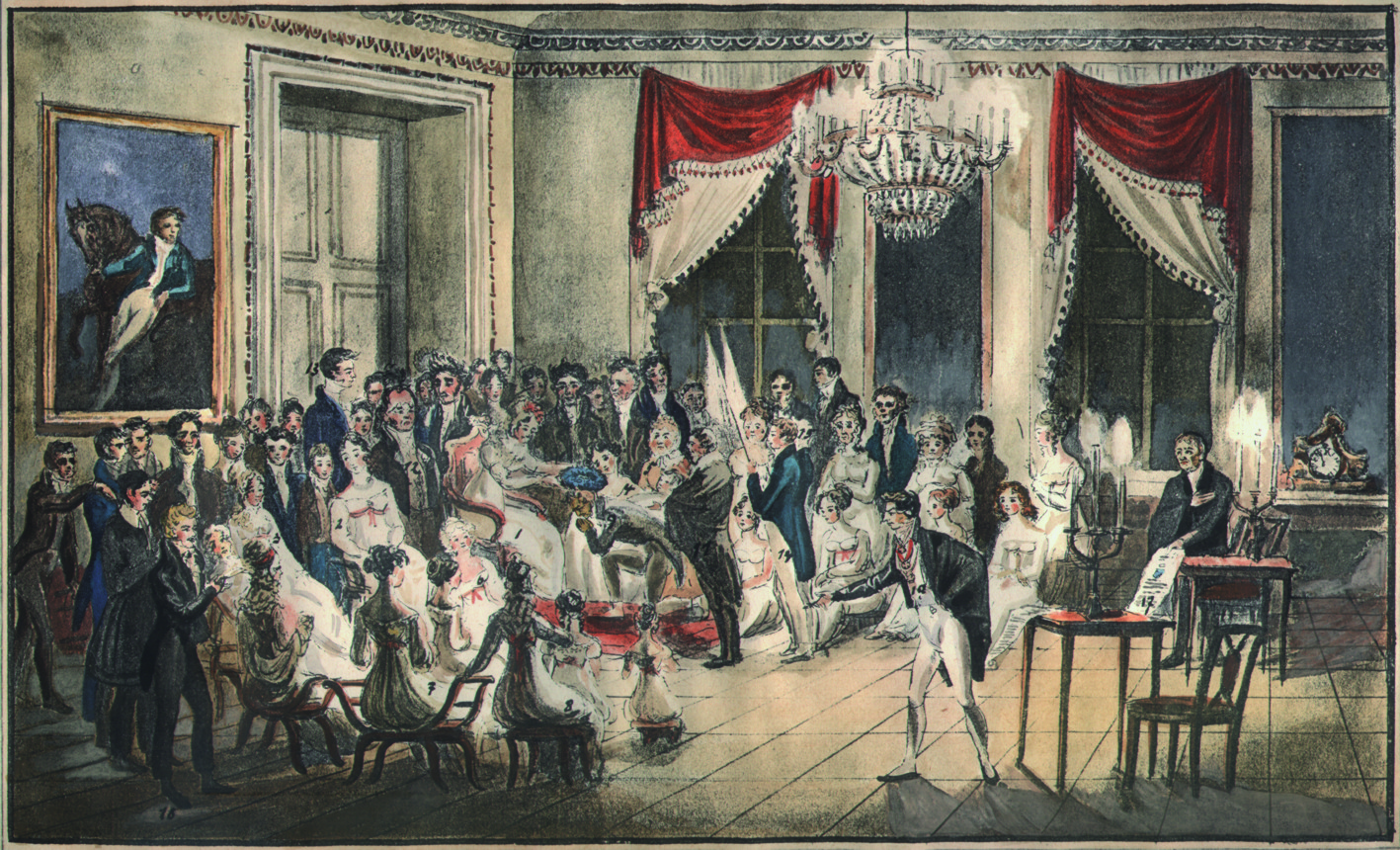
Aufnahme Frauenlobs des 2 ten am 8. September in Löbichau 1819, Aquarell, gemalt von Ernst Welker, Museum Burg Posterstein

One of the authors in Dorothea of Courland’s salon is honoured with a special prize in September in Löbichau 1819, painted by Ernst Welker, Museum Burg Posterstein

In Löbichau Emilie met among others the poet Jean Paul, Families Körner and Feuerbach, Carl August Böttiger, Friedrich Arnold Brockhaus, Christoph August Tiedge and Elisa von der Recke. Here she also became acquainted with her future husband: the Burschenschaftler (member of a student fraternity) August Daniel von Binzer. They married in 1822 in Sagan Castle. By using the pseudonym „Ernst Ritter“ Emilie von Binzer published a collection of novellas entitled „Mohnkörner“ („poppy grains“). In particular, people and experiences of the time of the Congress of Vienna influenced her literary work. She formed a close friendship with Adalbert Stifter and Franz Grillparzer.

The collection Welker at the open cultural data hackathon „Coding da Vinci“

In 2015 the Museum Posterstein Castle showed the collection of caricatures drawn by Ernst Welker for the first time within the framework of a special exhibition. Afterwards, the pictures were integrated to a touchscreen in the museum’s permanent exhibition. Since 2018 they are digitized and accessible via platform “Museums in Thuringia”. For the cultural hackathon Coding Da Vinci East the leaves are now to find in high resolution and with CC-BY-SA license also on Wikimedia Commons.


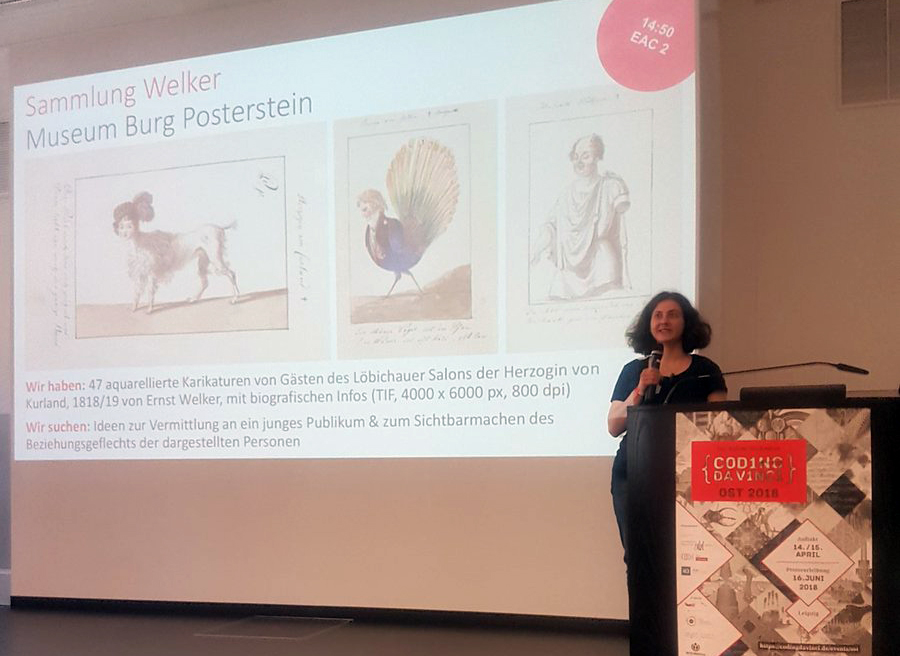
Unser erster Kultur-Hackathon: Die Sammlung Welker bei Coding da Vinci Ost in der Universitätsbibliothek Leipzig.

Our first hackathon: the Welker collection takes part in the hackathon Coding da Vinci in the university library in Leipzig.

In context of the hackathon some of the 140 participants – including designers, programmers and students of various disciplines – work with the data of the Museum Posterstein Castle. For the next nine weeks they’ll spend their free time to create modern playful applications by using the playful historical drawings. We will support them with professional information and we are very excited about the results, which will be presented on the 16th of June!

The projects can be followed in the Coding da Vinci Hackdash. There is even still the opportunity to join the project.

by Marlene Hofmann, translation: Franziska Engemann / Museum Burg Posterstein

#TravelsMW: Travel routes through Europe in the 18th and 19th centuries

Geschichte & Geschichten Veröffentlicht am 24. Juni 2017 von Museum Burg Posterstein24. Juni 2017

MuseumWeek:  we want to put travelling around 1800 in focus. Travel was undertaken on very different occasions. Scholars traveled to carry out their researches, to multiply and exchange knowledge. Young aristocrats were sent on „Cavalier’s Tours“, so that they could acquire the foundation of their training for the later court service at the foreign courts with the highest reputation. Travel to the Baths in Pyrmont or Karlsbad boomed. Artists flocked into the pulsating centers of European culture. A classic travel destination was Rome.

Educational journey

The focus on antiquity and the classical educational idea brought about a whole new travel culture – the educational journey. At first a privilege of the nobility, it became cultivated by the bourgeoisie. Those staying home could read the travelers‘ experiences in their travel tales and journals. Landscapes, habits, culture and art were described therein as well as travel itself, political daily business or martial events. A whole industry of publishing houses was concerned with the publication of travel reports.

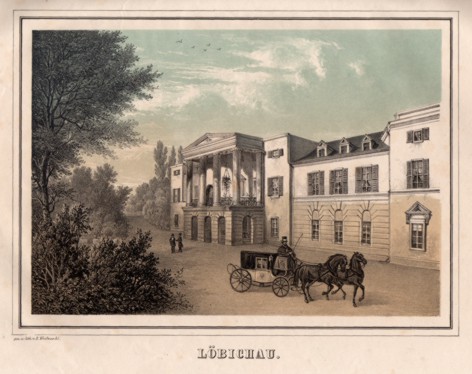
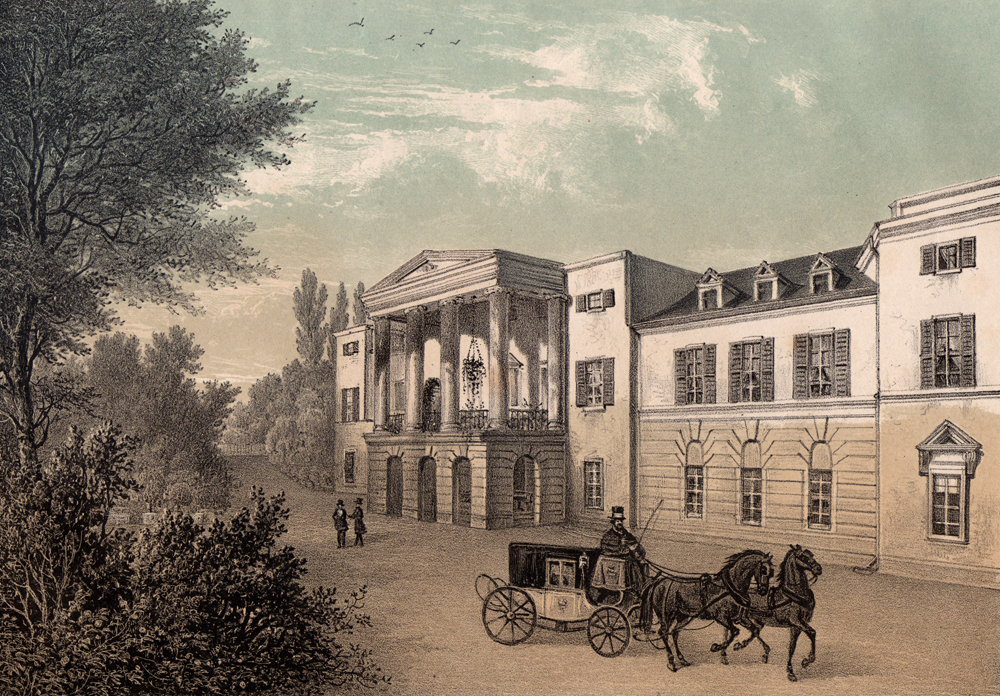
Schloss Löbichau ((c) Museum Burg Posterstein)

Löbichau Castle. Around 1800 it was usual to travel with the horse-drawn carriage. Poor roads, little light and hardly feathered coaches could quickly make the travel experience difficult.

Traveling at this time also meant hassle and abstinence of comfort. The roads were unsafe, in bad condition, dirty and even in large cities not always lit. Beds in the inns were infested with bugs. The horse-drawn carriages, poorly cushioned and ice cold in the winter, rocked and shook the passengers and brought little in comfort.

Sometimes insuperable obstacles forced the passengers to get out of the carriage

In France, Napoleon had straight avenues built, and good road connections were also reported from England. But in Germany most roads were unstable and poorly developed. There was often talk of axle breaks in the wagons, and it was not unlikely that the constant repairs to infrastructure and equipment were to generate good revenue for the local craftsmen.

Tolls and passport checks at the border stations cost time and money or even delayed the journey. Accordingly, trips took time, and it is said the distance from Berlin to Rome would have taken about two months to travel.

St. Petersburg – Paris – Vienna – Carlsbad: The Duchess of Courland was always on the move

Für eine Salondame wie Anna Dorothea von Kurland war eine musikalische Ausbildung ein Muss.

Salon host Anna Dorothea of Courland travelled through Europe many times.

Near the end of the 18th century, Castle Löbichau, along with the Tannenfeld Castle, developed into a center of intellectual and cultural life in Germany, just two kilometers from Posterstein. The Musenhof der Herzogin von Kurland of the Duchess of Courland, Dorothea of ​​Courland (1761-1821), in Löbichau was one of the most famous of its kind. The well-educated noblewoman drew important impulses from her first-class relations with the highest social circles in Europe and the associated network, and from her stays in famous salons of Berlin and Paris, as well as in the fashionable Carlsbad. She was acquainted with several important statesmen of her time.

Since the estates in Löbichau and Tannenfeld were conveniently located between the German cultural centers of the time, Anna Dorothea of ​​Kurland transformed them into a meeting place for the European elite by inviting artists, philosophers and leading politicians of her time. The most famous guest may well have been Czar Alexander I. of Russia (1777-1825).

Löbichau centrally located in Germany

The Duchess had chosen her estates not without reason. The two castles touched important routes of her time – strategically favorable, halfway between Berlin and Carlsbad, between Dresden and Erfurt and close to the intellectual centers of this time: Weimar and Jena. The nearby Ronneburg was still a health resort in the lifetime of the Duchess and thus a popular destination.

The travel experiences, at that time still in coaches, completely differed from the ones we make today. Nature, landscape and even the streets were perceived differently. A well-developed infrastructure enhanced the well-being of travelers. Breeches and bumps on the other hand could turn the trip into a seemingly endless odyssey.

The minister and the road construction

:

Hans Wilhelm von Thümmel’s priority were good streets and maps.

The roads in the Altenburger part of the duchy of Saxony-Gotha and Altenburg were easily navigable thanks to the efforts of the minister Hans Wilhelm von Thümmel (1744-1824). Writer Lili Parthey (1800-1829), sister of philologist Gustav Parthey (1798-1872), reported on the nature of routes at this time. She spent time with her brother and her parents at the Musehof of the Duchess Dorothea of ​​Courland (1761-1821) in Löbichau and can also be counted among the guests of the Thümmel family on their estate in Nöbdenitz. In her diary she wrote:

„Donnerstag, den 18. [7. 1816], war, obgleich die Welt untergehen sollte, das Wetter sehr schön. Ganz früh um 7 ging es fort; unsere Reise ging ziemlich schnell und sehr glücklich. Das Altenburgische Gebiet ist ein ganz wunderhübsches Ländchen, mit herrlichen Wegen und Aussichten. Die Verbesserungen der Landstraße und Wege sind vorzüglich Herrn von Thümmel zu danken. Wir empfanden diese Wohlthat doppelt nach den wahren Mordwegen von Leipzig bis Krona. […] Um 7 waren wir in Löbichau, dem Ziel unserer Bestimmung angekommen. Es ist ein reizender Aufenthalt.“

During one of her trips to Carlsbad Anna Dorothea of Courland met Johann Wolfgang von Goethe. It was just one of many encounters with poets, thinkers, politicians and well-known personalities of society. The Duchess had some formal encounters with Goethe in 1808, 1810, 1812 and 1820. In 1820 the poet even followed an invitation to Löbichau. On the 29th and 30th of September he spends cheerful hours and describes the castle of the duchess as a „well-located house of joy“. After this visit, he went on to Altenburg.

On the way from Schleiz to Gera on May 30., 1816:

„Von früh halb 4 – bis 8 Uhr Abends sind wir auf eine strecke von 7 u. eine halbe Meile gefahren die Wege sind überaus schlecht. Ich bin viel zu fuße gegangen u. wäre so nach Auma gelangt hätte der Wagen mich nicht daran behindert.“

The Duchess of Courland traveled much herself, and with pleasure. Paris, St. Petersburg or Vienna, Kurland, Switzerland or Italy – she was always drawn back to Löbichau. Thus is the case with her last journey in 1821. In May 1821 she finally set out from Paris, with her health in a bad condition at this time. The change from Paris to Löbichau is supposed to ease her suffering. On 30 June 1821 the Duchess‘ two daughters, Pauline and Johanna, leave. The mother describes this day as “a day of great mourning“. She will not see her daughters again.
On Aug. 20, Anna Dorothea of ​​Courland dies in her castle in Löbichau.

The daughters are already in Switzerland at this time. It’s not until May 9, 1822 that Johanna returned to Löbichau.
For the Duchess‘ funeral on August 29, 1821, 7000 guests arrived.

By Leon Walter & Franziska Engemann / Museum Burg Posterstein; translation: M. Huberti

History of European salon culture in Museum Burg Posterstein

Geschichte & Geschichten Veröffentlicht am 3. April 2016 von Museum Burg Posterstein8. Juni 2021

One of our favorite research subjects in Museum Burg Posterstein is European salon culture around 1800. – Not the first thing to think of when talking about a medievial castle. But only a view kilometres away from the regional history museum Burg Posterstein a popular salon hostess had her summer residence: Anna Dorothea of Courland (1761–1821) in the castle of Löbichau. Born in today’s Latvia the rich Duchess had wide connections to Europe’s high society.

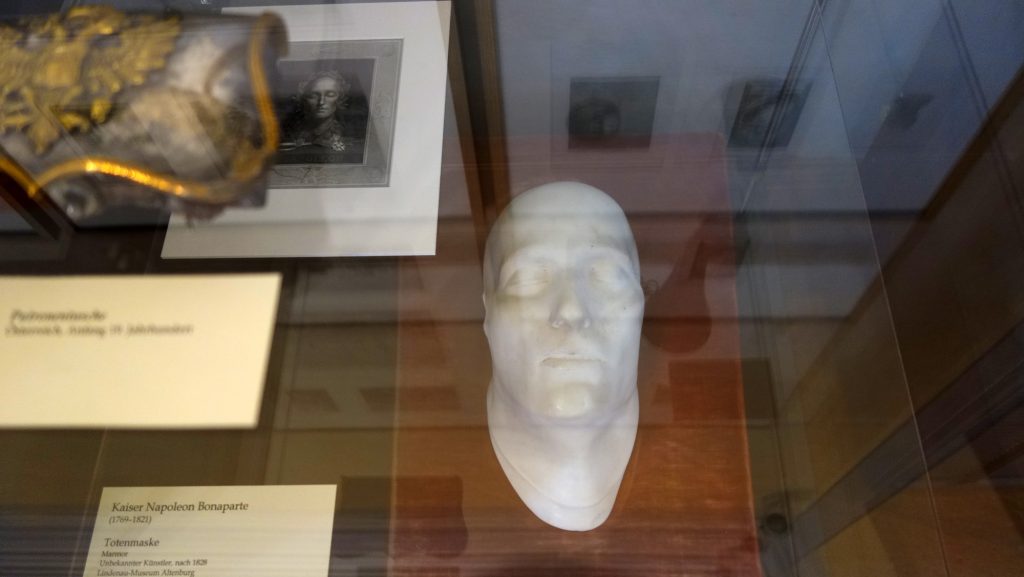
Napoleons Totenmaske in der Ausstellung des Museums Burg Posterstein
Napoleon’s death mask in the salon culture exhibition in Posterstein

That’s why Napoleon’s death mask is one of the first things to see, when you enter the salon culture exhibition in Posterstein. First enthousiastic about him, the Duchess of Courland became much more opposed against Napoleon during the time.

Anna Dorothea von Kurland - Ausstellung im Museum Burg Posterstein
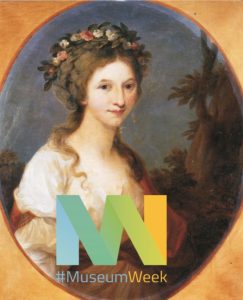
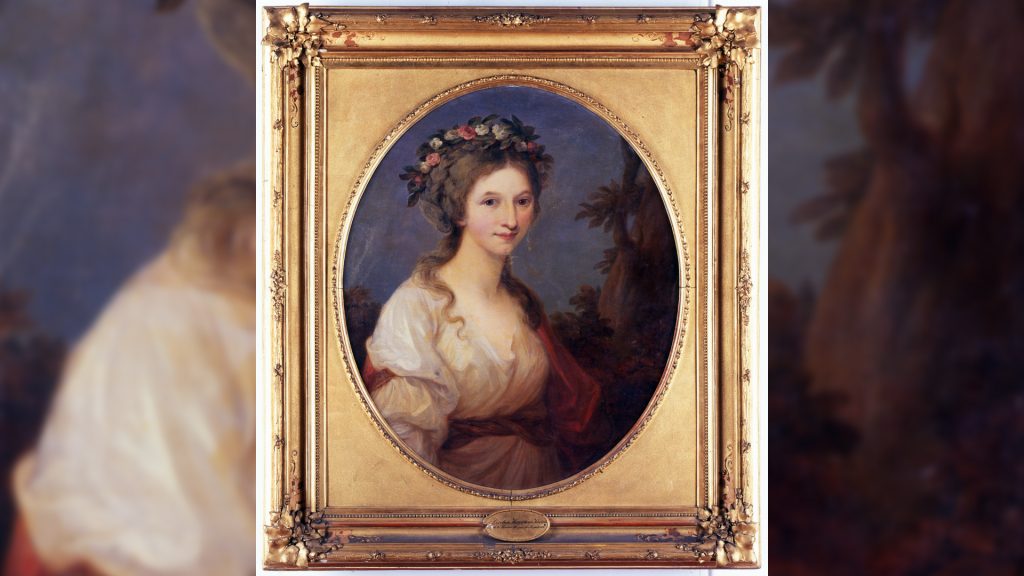
Portrait of Anna Dorothea von Kurland, a contemporary copy after a painting by Angelika Kauffmann, in the exhibition in the Museum Burg Posterstein

Anna Dorothea of Courland cultivated a livelong friendship to the French statesman Charles Maurice de Talleyrand (1754–1834).

Tsar Alexander I. (1777-1825) visited her 1808 in Löbichau and conveyed the marriage of her youngest daughter Dorothée (1793–1862) to Talleyrand’s nephew. At the Congress of Vienna Dorothee de Dino-Talleyrand accompanied Talleyrand and after his death she became his sole heir.

Anna Dorothea of Courlands oldest daughter Wilhelmine von Sagan (1781–1839) gained great influence an the congress as well, as she led a popular salon in Schenkenstraße in Vienna. From 1813 to 1815 she had a passonate relationship with Clemens von Metternich (1773–1859), the leader of the congress.

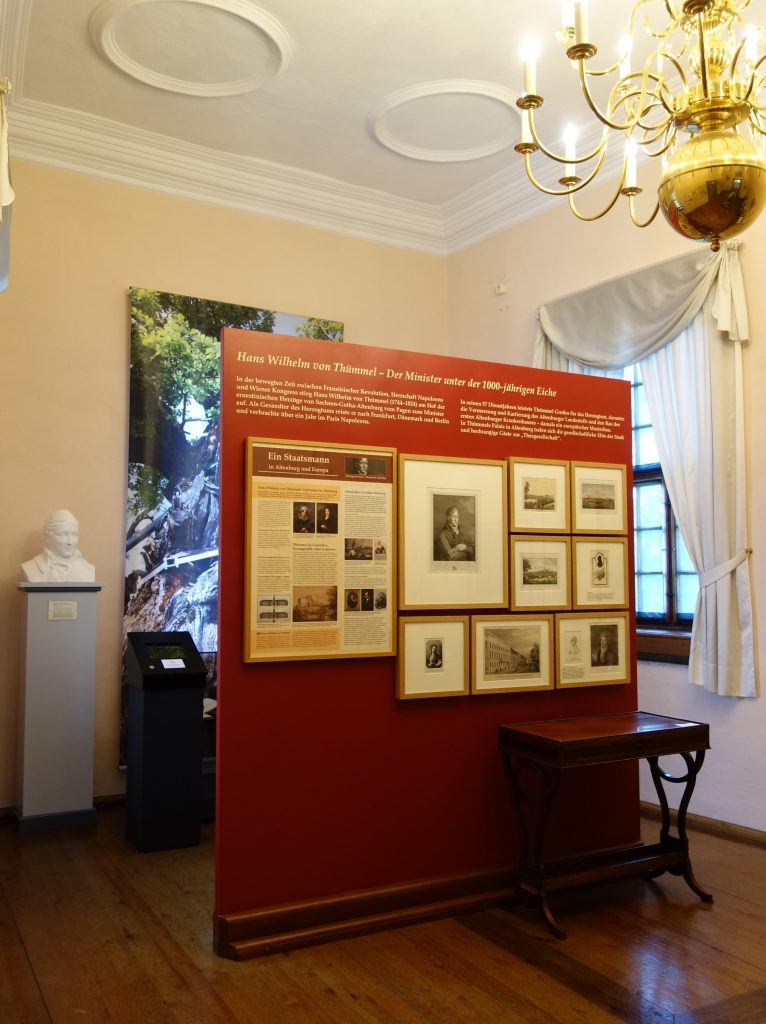
Blick in die Ausstellung zur Europäischen Salongeschichte im Museum Burg Posterstein in Thüringen.
The exhibition in Posterstein introduces the international and local network of the Duchess of Courland.

In Löbichau Anna Dorothea of Courland brought together poets, politicans and artists. Museum Burg Posterstein has been doing intensive research about this interesting women’s life and the lifes of her daughters for more than 20 years.

The museum is cooperating with the French history society Les Amis de Talleyrand. The cooperation was officially recorded with a contract between the Museum society Burg Posterstein (Museumsverein Burg Posterstein) and Les Amis de Talleyrand in 2015.

In 2021 the permanent exhibition is being re-designed. The new exhibition, then with English summeries, can be seen from August, 1st, 2021.

Von Marlene Hofmann / Museum Burg Posterstein, last updated: June 2021

Further reading:
A cultural salon in Löbichau
Cooperation with Les Amis de Talleyrand (in German)
Bertel Thorvaldsen’s busts of Wilhelmine von Sagan (in German)

#PeopleMW: Romantically minded minister of Saxe-Gotha-Altenburg burried under a 1000 year old oak

Geschichte & Geschichten Veröffentlicht am 29. März 2016 von Museum Burg Posterstein21. Januar 2017

LogoMW_PostersteinIt’s #MuseumWeek on Twitter and in other social networks. Today’s slogan is #peopleMW. Posterstein Castle focusses this year on Hans Wilhelm von Thümmel (1744–1824), a minister of the Duchy of Saxe-Gotha-Altenburg, who chose himself a very special burrial plot.

Hans Wilhelm von Thümmel (Museum Burg Posterstein)

Hans Wilhelm von Thümmel (Museum Burg Posterstein)

Starting his carrier at court in Gotha as a „page“ in 1760, he became minister in 1805. Between 1803 and 1808 he was – with diplomatic mission – travelling to Denmark, Berlin, Königsberg (Kaliningrad), Dresden and Paris. In Paris Napoleon received him in audience.

As a friend of Duke Ernst II of Saxe-Gotha-Altenburg (1745–1804) Thümmel’s influence on court was huge. Today he is still known for his engagement in the county of Altenburg: He founded one of the first banks, supported the building of roads, mapped the region and founded the local hospital in Altenburg. In Thümmel’s house in Altenburg the local high society met for tea, among others his older brother, the writer Moritz August von Thümmel (1738–1817).

Thümmel’s old-age residence close to Posterstein

Minister with sence for poetry: Thümmel's aphorisms

Minister with sence for poetry: Thümmel’s aphorisms

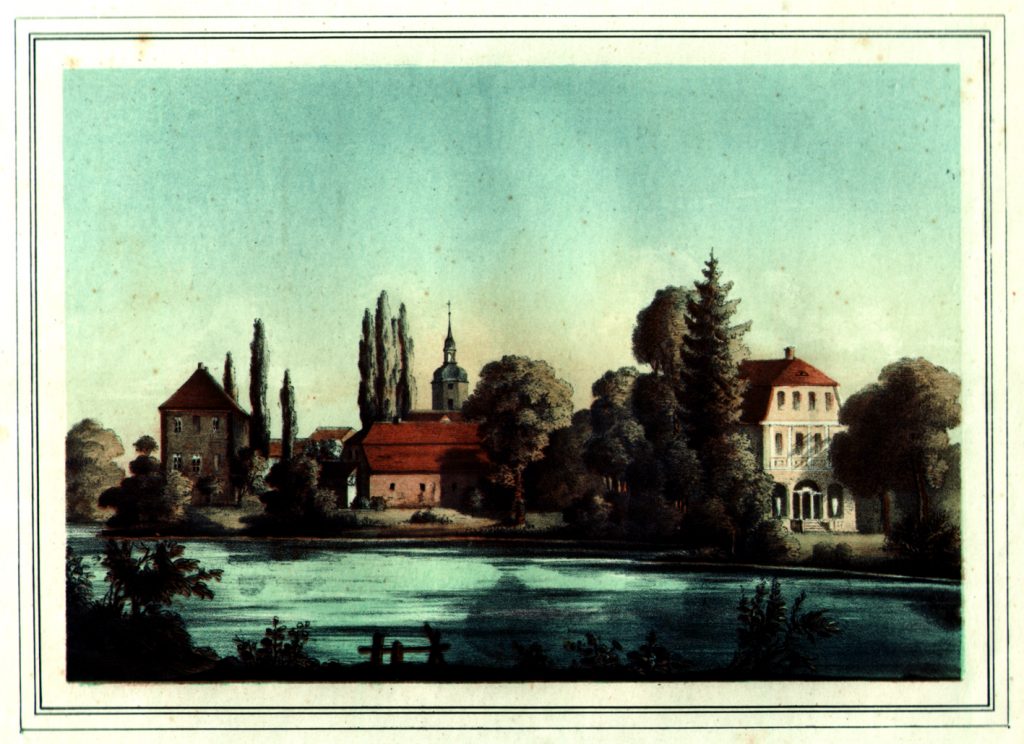
When he retired, Thümmel lived mostly in his castle in Nöbdenitz near Posterstein. In the countryside around the castle, Thümmel had a pleasure garden and a path along the lake invited the guest to dander. Friends of the family, as the Duchess Dorothea of Courland (1761–1821), who had her summer residence near-by in Löbichau castle, came to visit Nöbdenitz to sail on the lake and to enjoy the garden. Thümmel was member of the Duchess‘ poets club and published several books with witty aphorisms.

Before his death Hans Wilhelm von Thümmel decided to get buried at an inconvenient place – under the so-called 1000 year old oak of Nöbdenitz. He bought the tree from the local church and let arrange a grave between the tree’s roots. The writer Emilie von Binzer (1801–1891), guest in Löbichau, met Thümmel when she was a young girl. She noted in her book „Three summers in Löbichau“ („Drei Sommer in Löbichau“) that Thümmel was old as the hills by the time she met him and that he had an old oak in standby state to be burried underneath.

View of the 1000 year old oak tree from 19th century (Museum Burg Posterstein)

View of the 1000 year old oak tree from 19th century (Museum Burg Posterstein)

Still burried under the 1000 year old oak tree

This grave was inspected in 1959 by the local teacher and historian Ernst Bräunlich. He documented that there was a small oratory with a wooden bench inside the hollow tree, to commemorate the dead. The minister’s body lies in a coffin parallel to the street. Today one can only look at the tree from outside. A sign tells its story. Only parts of the castle complex and garden outlived the years of the German Democratic Republic.

In connection to the Thuringian state exhibition on the Ernestiner family the museum Posterstein Castle shows an exhibition on Hans Wilhelm von Thümmel opening June, 26th. A book will be published as well.

By Marlene Hofmann / Museum Burg Posterstein
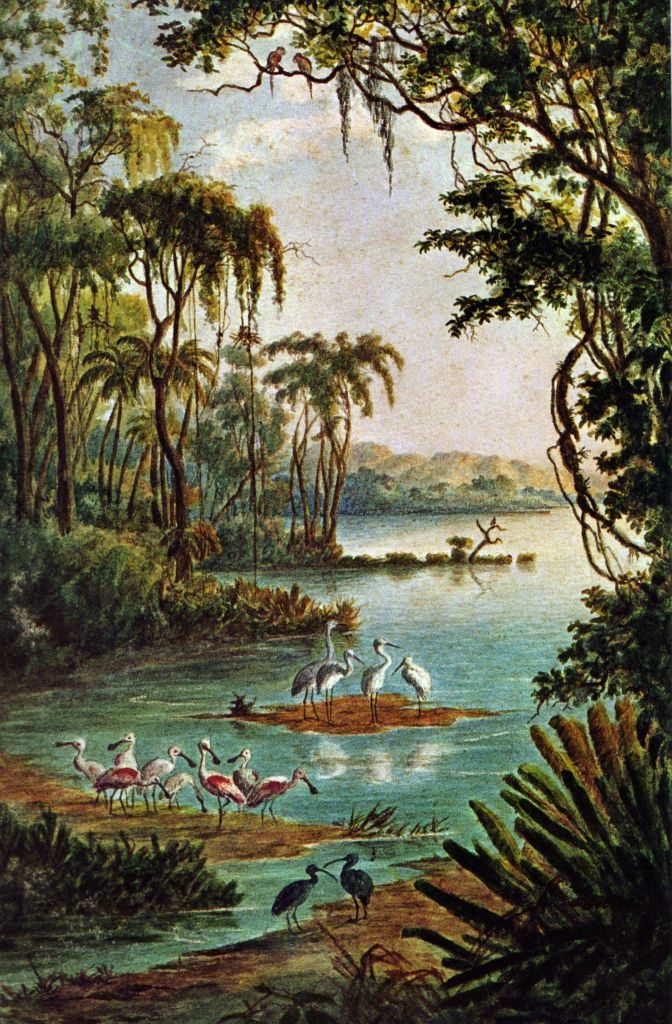
More information:
Exhibition from June 26th to October 30th
Thümmel in Nöbdenitz
The Duchess Anna Dorothea of Courland

An important strategically centre: Altenburg during the battle of Leipzig

Geschichte & Geschichten Veröffentlicht am 30. August 2013 von Museum Burg Posterstein21. Januar 2017

Karl Philipp Fürst zu Schwarzenberg was commander-in-chief of the allied armies against Napoleon in 1813

Karl Philipp Fürst zu Schwarzenberg was commander-in-chief of the allied armies against Napoleon in 1813 (picture: Museum Burg Posterstein)

Karl Philipp Fürst zu Schwarzenberg, commander-in-chief of the 1813 allied armies against Napoleon, planned to occupy the town Altenburg as a strategically important place. From Altenburg further military actions against Napoleon could be planned. Also the Saxon, Russian and Prussian general Johann Adolf Freiherr von Thielemann (1765-1824) emphasized in a letter to Schwarzenberg on October 3rd 1813 the militarily advantages of the town, that has a castle lying high up on a hill that could easily be defended.

Tsar Alexander I. arrived in the evening

In fact Altenburg was the right place to accommodate thousands of soldiers as well as supreme commanders, generals, diplomats and their entourage over a longer period. On October 7th 1813 the allied troops occupied Altenburg. The headquarters were moved there from the town Penig. Tsar Alexander I. arrived on the same day and resided in Altenburg castle. Thereafter the Austrian foreign minister Metternich, the English legate Cathcart, the Russian diplomat Nesselrode and other politicians and important brass arrived.

On October 14th the Austrian emperor Franz received a message from Schwarzenberg that a stay in Altenburg would be save. The Prussian king and the Austrian emperor reached Altenburg on October 15th and stayed in the castle as well.

A town with 10.000 inhabitants accommodated more than 500.000 soldiers

Special exhibition on the battle of Leipzig in the museum Posterstein Castle near Altenburg

Special exhibition on the battle of Leipzig in the museum Posterstein Castle near Altenburg

In the year 1813 altogether 671 generals, 46.617 officers and 472.399 soldiers have been accommodated in the small town Altenburg, that had about 10.000 inhabitants at that time. Only in September and October 1813 the town spent the unbelievable amount of 147.681 thaler on the supply of the troops.

There is existing a detailed record (view here on Google books) on the year 1813 in Altenburg, written by the minister of finance of the town Altenburg, Friedrich Wagner (1792-1859). He is describing, how the citizens of Altenburg, all the villages and farms near-by and other towns in the neighbourhood (as Borna, Meuselwitz, Gera, Zeitz) had to deliver a substantial quantity of food, cattle, textiles and other things to the different armies.

All houses had to shelter 2, 3 or more wounded soldiers

Prisoners and wounded soldiers had to be accommodated and taken care of as well. The canon fire of the battle of Leipzig, 9 hours walk from Altenburg, could be heard in the town as well. After the first fights, masses of wounded soldiers arrived in Altenburg – and with them epidemic deceases. Nearly all official buildings of the town were already used some military hospitals, so that all houses in the Altenburg had to house 2, 3 or more wounded soldiers.

„Heaven help us to harvest“

The farms and manors in the region felt the war as well. Anna Dorothea Duchess of Courland, who owned the manor Löbichau near Posterstein, wrote in her letters from July and August 1813 that there was no day without soldiers who had to be accommodated. Often they took all food and horses with them. Special war taxes had to be paid and workers and farmers were recruited as soldiers. „Heaven help us to harvest“, the Duchess wrote to her friend. – Years after the wars of liberation from Napoleon the people of Altenburg had to pay special taxes to pay the war debts of the Duchy of Saxon-Altenburg.

Special exhibition at Museum Posterstein Castle

Plakat Sonderausstellung "Napoleon - IM Spiegel zeitgenössischer Karikaturen" im Museum Burg Posterstein
Poster of the special exhibition „Napoleon – IM Spiegel zeitgenössischer Karikaturen“ in Museum Posterstein Castle in 2013

The Museum Posterstein Castle, regional history museum in the county of Altenburg, shows from September 1st to November 17th 2013 a special exhibition on the battle of Leipzig, which now is 200 years ago. Basis for the exhibitions are about 50 Napoleon caricatures, Wagner’s record of Altenburg in 1813 and original military letters from 1813. On October 13th a book will be published as well (in German). For more information, contact the museum at info@burg-posterstein.de.
(Marlene Hofmann / Museum Burg Posterstein)

Moving from Altenburg to Altenburg

Geschichte & Geschichten Veröffentlicht am 18. März 2011 von Museum Burg Posterstein21. Januar 2017

How German settlers in 19th century founded a new hometown in Missouri

A motley group of emigrants from Saxony-Altenburg, Dresden region and Hannover stranded on a rock in Mississippi river in 1839. Right beside the river the strict Lutheran settlers founded the town Wittenberg. Frequently the legendary river carried Wittenbergs houses away – that is why only the Wittenberg Boat Club and a crumbling old post office remind of the town today.

rock in Mississippi

After a long journey by ship a group of German emigrants from Altenburg County stranded at this rock in Mississippi in 1839.

The emigration was organized by different clergymen, under the leadership of reverend Martin Stephan from Pirna near Dresden. As a result of social problems after the Napoleonic Wars and tightened taxes in the countryside, parallel to first revolutionary riots, a lot of people in Altenburg region considered to try out their luck in the „new world“. In the beginning they considered Australia as a new home as well, but south from St. Louis in Missouri they were offered 10.000 acre land to a cheap price.

Wittenberg Boat Club

Wittenberg Boat Club

In Winter 1838/39 five ships with settlers from the kingdom of Saxony and the duchy of Saxony-Altenburg headed for the so called „new world“. The devotional emigrates took 900 copies of Luther’s catechism with them on board of the ships. Even during the long crossing the children were taught. All ships reached the US, except for a small boat called „Amalia“, which apparently collided with a bigger ship near France.

Altenburg, Dresden, Wittenberg, Frohna, Paitzdorf and Seelitz in the „new world“

As mentioned before, the settlers arrived in Missouri in 1839. At that time this region still was a nearly uninhabited wilderness. The newcomers probably wouldn’t have survived the first winter, if they wouldn’t have been supported by the Lutheran community in St. Louis. In today’s Perry County the German settlers founded towns, which they named after the regions and towns they came from – like Dresden, Seelitz, Johannisberg, Altenburg, Frohna, Paitzdorf and Wittenberg. Dresden, Seelitz and Johannisberg were later on suburbanized by Altenburg, Missouri. Of course the emigrants only reported the best things to their friends and families in Germany and in the following years a lot of other people from Altenburg region moved to the new founded Altenburg.

You don’t need to fear Indians, wild animals and Mexican soldiers in Altenburg

Reverend Martin Stephan lived a very little moral life in the new world, while he let himself celebrate as a king. When the community finally had realized how badly their spiritual leader had betrayed them, they dismissed him. The first president of the Missouri synod, which has two million members today, was Ferdinand Wilhelm Walter from Langenchursdorf. Gotthold Heinrich Loeber from Kahla overtook the job as reverend in the new founded Altenburg. In a letter to Germany on September 10th, 1839 he described the life in the new world, where the most people at this time did still not live in houses, but in temporary sheds. To comfort his reader he added that one did not have to fear Indians, wild animals or Mexican soldiers in Altenburg.

school building from 1839 in Altenburg Missouri

The school building from 1839 is the oldest house in Altenburg, Missouri.

As one of their first projects, the settlers built a school in august 1839 to provide grammar school education for the children: Religion, Latin, Greek, Hebrew, German, French, English, history, geography, mathematics, physics, natural history, philosophy, music and drawing were on the schedule. The goal was to prepare the pupils for later university studies. In the first year seven boys and three girls were enrolled.

Welcome to Altenburg, Missouri!

In October 2010 historians from the German Altenburg travelled to the American Altenburg to take part in an international conference named „Home is where our story begins“. Already decades before the genealogist Wilfried Piehler from Gera (Thuringia) established first contacts to Missouri. Inhabitants from Altenburg, Missouri, have already a few times visited Altenburg County in Germany. Some of them surprised the Germans by speaking German with Altenburg dialect from 19th century.

Altenburg Missouri

The American Altenburg is a gemuetlich small town with a living Christian community.

On the two-day conference local historians and genealogists from Missouri presented their research on the history of the town. German historians, as Sabine Hofmann from Lindenau Museum Altenburg, described the history of the German Altenburg. On Friday, March 18th, 7pm, Wilfried Piehler and Klaus and Sabine Hofmann will present the results of this conference at Posterstein Castle. To learn more about the history of Altenburg, Missouri, you should take a look at the book „Altenburg Missouri and the surrounding Parishes” (editor: Mary Beth Mueller Dillon, Lynhorst, Indianapolis, 2010).

(by Marlene Hofmann, also published in Ostthüringer Zeitung, March 16th 2011, http://www.otz.de/)

Geschichte & Geschichten

Das thüringische Museums Burg Posterstein bloggt seit 2011 über Geschichte und Geschichten aus Sammlung, Forschung und Museumsalltag.

IN ENGLISH: Since 2011 the German Museum Burg Posterstein writes stories about its collection, research and everyday life at the museum – here you find all texts in English.
Folgen Sie uns!

Logo YouTube     Logo Twitter      Logo Facebook     Logo Instagram      Logo Pinterest

Neuste Artikel:

  • The Welker Collection from Posterstein is heading to Courland
  • Postersteiner Sammlung Welker reist nach Kurland
  • Jahresrückblick 2025: Erfolgreiches Museumsjahr trotz Bauarbeiten
  • Sanierung des Bergfrieds der Burg Posterstein 2025
  • Sonst nichts Neues? – Resümee zur Sonderschau

Themen

  • Auf Deutsch (329)
    • #GartenEinsichten (4)
    • #SalonEuropa (7)
    • #Schlössersafari (12)
    • 16. Jahrhundert (3)
    • 17. Jahrhundert (6)
    • 18. Jahrhundert (7)
    • 19. Jahrhundert (72)
    • 20. Jahrhundert (13)
    • 21. Jahrhundert (6)
    • Adventskalender2020 (24)
    • Anderes (51)
    • Blogparade #SalonEuropa (8)
    • Ernestiner 2016 (16)
    • Kinderburg (27)
    • Kinderburg – DIY (7)
    • Kinderburg – Tour (1)
    • Kunst (25)
    • LeseZEIT (9)
    • Mittelalter (13)
    • Museumsverein (18)
    • Museumswelt (94)
    • Quer durch die Jahrhunderte (45)
    • Rittergüter (29)
    • Salongeschichte (15)
    • Sonderausstellungen (106)
    • Uranerzabbau (6)
  • In English (29)
    • 19th century (10)
    • Castles and manor houses (12)
    • Crossing centuries (5)
    • medieval times (1)
    • museum & social media (4)
  • Uncategorized (1)

Die Kinderburg

Kinderburg-Blog

Podcast LeseZEIT

Banner Podcast LeseZEIT auf Burg Posterstein

Digitale Ausstellungen

Landschaft nach der Wismut

Banner Landschaft nach der Wismut - eine digitale Ausstellung - im Hintergrund sieht man die neue Landschaft Ronneburg

#SalonEuropa
 Banner Online_Ausstellung SalonEuropa des Museum Burg Posterstein
#Schlössersafari

Banner Online-Ausstellung Schlössersafari

Weihnachtskrippen

Banner digitale Weihnachtsausstellung des Museums Burg Posterstein

Kontakt & Öffnungszeiten:

Museum Burg Posterstein
Burgberg 1
D-04626 Posterstein

Telefon: (034496) 22595

Aktuelle Öffnungszeiten

Impressum und Datenschutz

Impressum

Datenschutz

Museum Burg Posterstein in Thüringen - Ansicht vom Burgpark

Kontakt

Museum Burg Posterstein
Burgberg 1
D-04626 Posterstein
Telefon: (034496) 22595

Aktuelle Öffnungszeiten

Impressum und Datenschutz

Impressum

Datenschutz

©2026 - Geschichte & Geschichten Datenschutzerklärung
↑